

Table of Contents
- 1. Wynwood Freebees enhances connectivity with new routes
- 2. Expansion of Wynwood Freebees Service
- 3. New Connection to Miami’s Metromover
- 4. Free Transportation Options for Visitors
- 5. Accessibility Improvements in Wynwood
- 6. How to Request a Free Ride
- 7. Impact on Traffic and Parking in Wynwood
- 8. Community Benefits of the Expansion
- 9. Sustainability and Environmental Goals
- 10. Public Reception and User Experience
- 11. Exploring the Future of Wynwood Freebees
- 11.1 The Role of Technology in Enhancing Mobility
- 11.2 Community Engagement and Feedback Mechanisms
Coverage note: This update is written from the perspective of HireDriverMiami.com’s Miami transportation blog, focused on practical, visitor-friendly ways to get around neighborhoods like Wynwood, Downtown, and Brickell.
Wynwood Freebees enhances connectivity with new routes
Wynwood Freebee Service Updates
What’s new in this update:
– Expanded coverage: Wynwood Freebees now includes Edgewater and Midtown.
– New transfer point: a connection to Miami’s Metromover at the 15th Street station.
– Key rule stays the same: every trip must start or end in Wynwood (it’s a connector into/out of the district, not unlimited free rides anywhere).
- Wynwood’s free, on-demand Freebee electric rides are expanding to include Edgewater and Midtown.
- A new link to the Metromover at the 15th Street station aims to make car-free trips from Downtown and Brickell to Wynwood easier.
- The Wynwood BID says the goal is better access, more foot traffic, and less parking hassle in the Arts District.
- Riders can request trips via the Freebee app, by phone, or by hailing vehicles where available—within geofenced zones.
Expansion of Wynwood Freebees Service
Wynwood’s signature hot-pink-and-black electric vans are about to cover more ground. The Wynwood Business Improvement District (BID) is expanding its Freebee electric ride service to include Edgewater and Midtown, widening the free, on-demand mobility network that has become a familiar sight in the Wynwood Arts District.
The premise remains simple: riders can request a free trip in an all-electric vehicle, with the service designed to move people around without requiring a personal car. But the expansion changes what “getting to Wynwood” can look like—especially for residents and visitors who live nearby or who are already moving through Miami’s core neighborhoods.
David Lombardi, chairman of the Wynwood BID, framed the move as a direct response to the district’s popularity and the friction that comes with it. “This expansion is all about making Wynwood more accessible,” he said, pointing to Edgewater, Midtown, Downtown, and Brickell as key origins for people who want to reach Wynwood’s galleries, restaurants, and cultural events.
All rides must either begin or end within Wynwood. That means the expanded service is not simply a free ride anywhere; it is a mobility bridge into (and back out of) the district—supporting the idea of Wynwood as a destination while still giving people a practical way to arrive without circling for parking.
The BID’s stated intent is twofold: reduce the need for visitors to drive and increase foot traffic once people arrive. In a neighborhood built on walking between murals, galleries, restaurants, and venues, the last-mile connection can determine whether a trip feels easy—or not worth the hassle.
| What’s changing | Before the expansion | With the expansion | What it means in practice |
|---|---|---|---|
| Coverage area | Centered on Wynwood | Adds Edgewater + Midtown | More people can start closer to Wynwood without driving into the district |
| Downtown/Brickell access | Indirect (drive/park or rideshare) | Adds a Metromover connection at the 15th Street station | A clearer car-free path for visitors already in the urban core |
| Trip eligibility | Wynwood must be one end of the trip | Same rule remains | It’s a “to/from Wynwood” connector, not a free ride across the whole city |
| How you request | App / phone / hail (where available) | Same options | No new learning curve—just more places it can work |
New Connection to Miami’s Metromover
Metromover to Wynwood Ride Flow
A practical “Metromover → Freebee → Wynwood” flow (with quick checkpoints):
1) Ride the Metromover toward the 15th Street station.
2) When you arrive, open the Freebee app (or call (855) 918-3733).
3) Set your pickup near the station and choose a drop-off in Wynwood.
4) Checkpoint: confirm your trip qualifies—Wynwood must be the start or end point, and both points must fall inside the active geofenced zones.
5) Meet the vehicle (look for the distinctive hot pink and black two-tone fleet).
6) For the return: request another ride with Wynwood as one end of the trip (back to the Metromover connection or to Edgewater/Midtown).
The most consequential piece of the expansion may be the new connection to Miami’s Metromover at the 15th Street station. In practical terms, it creates a free, convenient option for travelers coming from Downtown and Brickell to reach Wynwood without a car—by pairing a fixed-route transit spine with an on-demand electric shuttle for the final leg.
For visitors staying in Downtown hotels or Brickell high-rises, the challenge is often not the distance to Wynwood but the “in-between” logistics: deciding whether to drive, pay for parking, or rely on rideshare during peak nightlife hours. The Wynwood BID’s bet is that a Metromover-to-Freebee handoff can make the decision easier—especially for people who already prefer transit for part of their trip.
The service design also reflects how Miami trips actually happen. Downtown and Brickell are dense, active areas where travelers may already be walking, using transit, or avoiding driving. By anchoring the expansion to a Metromover station, the program positions Wynwood as a reachable add-on to a day or night out—without turning the trip into a parking hunt.
Mr. Lombardi described the expansion as a way to create “new, free ways to reach the Wynwood Arts District,” explicitly tying the Metromover link to reducing the need to drive. The connection is also a statement about Wynwood’s evolution: it is no longer a standalone pocket that people “drive to,” but part of a broader urban circuit that includes Downtown and Brickell.
The Metromover connection functions like a gateway. Riders can arrive at the 15th Street station, request a Freebee into Wynwood, and later use the same link to return—keeping the service focused on access to the district rather than general-purpose transportation.
Free Transportation Options for Visitors
For visitors, “free transportation” can sound too good to be true—until you understand what Wynwood Freebees is (and isn’t). The service offers free, on-demand rides in all-electric vehicles, with drivers compensated through optional gratuities. In other words, the fare is zero, but tipping is part of the ecosystem.
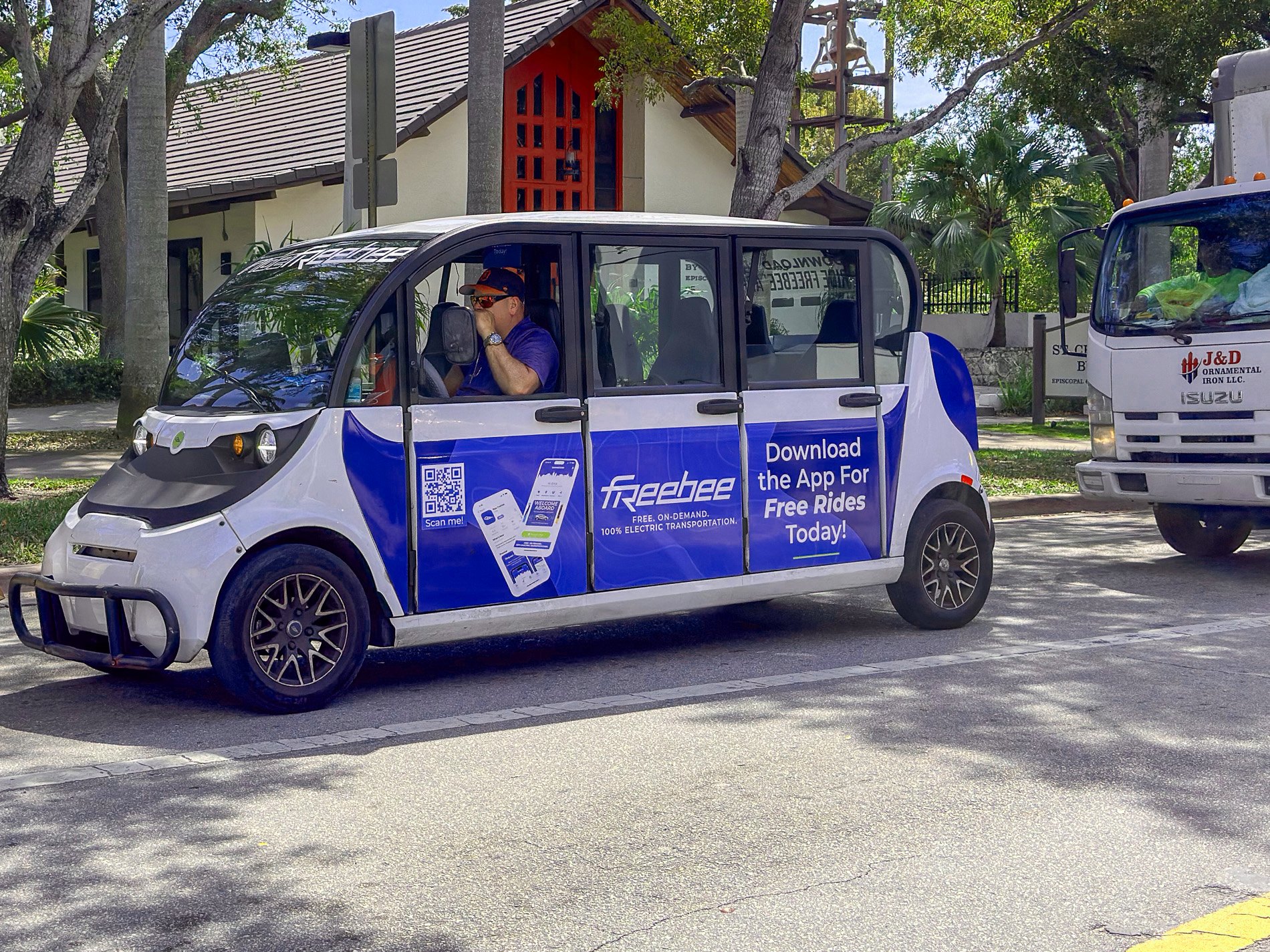
The vehicles themselves are part of the appeal. Freebee’s fleet in Wynwood includes electric Volkswagen ID vans, and the service is known for its distinctive two-tone look—hot pink and black—making it easy to spot on the street. That visibility matters in a busy district: visitors don’t have to wonder whether the van pulling up is the right ride.
Access is designed to be flexible. Riders can request pickups via the Freebee app (available on iOS and Android), call dispatch, or—where available—hail vehicles directly from the street. That mix caters to different kinds of travelers: the app-first tourist who wants real-time tracking, the visitor with a low battery who prefers a phone call, or the spontaneous group that spots a van and tries their luck.
Service hours, as listed for the Wynwood BID area as of Feb. 18, 2026, run Monday to Wednesday from 11:00 AM to 10:00 PM and Thursday to Sunday from 11:00 AM to 11:00 PM. Those hours align with the rhythms of Wynwood: daytime gallery visits and shopping, then dinner and nightlife later in the week.
The key constraint is geography. Rides must begin or end in Wynwood. For visitors, that means the service is best understood as a “last-mile” connector—helping you get into Wynwood from nearby areas (including the new Edgewater and Midtown coverage and the Metromover link), and helping you move to or from Wynwood without needing to drive.
For anyone planning a Wynwood outing—especially on a weekend—this can change the calculus: arrive by transit or from a nearby neighborhood, use Freebee to bridge the gap, and skip the parking stress entirely.
| Option | Best for | What you’ll need | What to expect | Watch-outs |
|---|---|---|---|---|
| App request | Most visitors; anyone who wants visibility | Smartphone + data | Real-time vehicle tracking + clearer service boundary visibility | Pickup/drop-off still must follow geofence rules; Wynwood must be one end of the trip |
| Call dispatch | Low battery, no app, or you prefer a person | Phone call to (855) 918-3733 | Human-assisted request | You may have less “map-style” clarity than the app provides |
| Street hail (where available) | You see a van nearby and want to hop in | Being in an active service area | Fast if a vehicle is circulating | Not guaranteed; availability varies by time and location |
Accessibility Improvements in Wynwood
Reducing Barriers to Access
A simple way to think about “accessibility” in this expansion:
– Cost barrier: the ride itself is free (optional gratuities), which can make short trips more doable.
– Convenience barrier: on-demand pickup reduces the need to plan around a fixed schedule.
– Boundary clarity: geofenced zones + in-app maps reduce “will this work?” uncertainty.
– Last-mile gap: the Metromover connection + Edgewater/Midtown coverage helps bridge the hardest part of a car-free trip.
Wynwood’s popularity is a double-edged sword: the same galleries, restaurants, and cultural events that draw crowds also create friction for getting in and out. The Wynwood BID is positioning the Freebee expansion as an accessibility upgrade—less about novelty, more about making the district function better for the people who want to be there.
“This expansion is all about making Wynwood more accessible,” BID chairman David Lombardi said, emphasizing that visitors coming from Edgewater, Midtown, Downtown, or Brickell now have “a free, convenient way” to reach Wynwood’s core attractions. Accessibility here is not limited to physical infrastructure; it’s about reducing barriers like cost, complexity, and the uncertainty of parking.
The service’s on-demand model matters in a neighborhood where plans change quickly. A group might start at a gallery, decide to grab dinner, then head to a cultural event—often within the same evening. Freebee’s ability to be requested when needed (rather than waiting for a scheduled bus) is part of what the BID is selling as “convenient.”
Geofenced zones also shape accessibility in a specific way: they create predictable service boundaries. For the most up-to-date service boundaries and details, Freebee directs riders to the Freebee app and ridefreebee.com. Riders can use the app or the website to see where the service operates, which reduces the guesswork that can come with informal shuttles or limited-route circulators. The rule that rides must start or end in Wynwood keeps the focus on access to the district, reinforcing Wynwood as the anchor point.
The expansion to Edgewater and Midtown adds more entry points. Instead of accessibility being limited to those already in Wynwood, the service becomes a connector from adjacent neighborhoods—places where people live, stay, or pass through on the way to other destinations.
Finally, the new Metromover connection at the 15th Street station extends accessibility beyond immediate neighbors. It effectively ties Wynwood into a broader car-free network that includes Downtown and Brickell—two areas where visitors and residents may already be moving without a vehicle.
In a district built around walking once you arrive, the biggest accessibility hurdle is often the first and last mile. The BID’s strategy is to make that hurdle smaller—and make the decision to visit Wynwood easier.
How to Request a Free Ride
Quick Ride Request Tips
Before you request a ride (quick, practical checks):
– Decide how you’ll request: app, call (855) 918-3733, or street hail (where available).
– Confirm your trip fits the rule: Wynwood must be either your pickup or your drop-off.
– Check your location: both ends of the trip need to be inside the active geofenced zones.
– If using the app: use the map to confirm boundaries and track the nearest vehicle.
– If hailing: look for the hot pink and black two-tone vans.
Requesting a Wynwood Freebees ride is designed to be straightforward, with multiple options depending on how you prefer to travel.
1) Use the Freebee app.
The Freebee app is the most information-rich option, offering real-time vehicle tracking and a clear view of service boundaries. Because the service operates within designated geofenced zones, the app helps riders understand whether their pickup and drop-off points qualify—and how close the nearest vehicle is.
2) Call dispatch.
Riders can also request a ride by phone at (855) 918-3733. This option can be useful for visitors who don’t want to download another app, who are traveling with someone else’s phone, or who simply prefer a human-assisted request.
3) Hail a vehicle from the street (where available).
In some cases, riders can hail Freebee vehicles directly. This can work well in busy Wynwood corridors where vans are circulating and visibility is high—especially given the fleet’s distinctive hot pink and black two-tone design.
No matter which method you choose, the same operating rules apply. Freebee runs within geofenced zones, and all rides must either begin or end within Wynwood. With the expansion, that means you can travel into Wynwood and return to Edgewater, Midtown, or the Metromover connection—so long as Wynwood is one end of the trip.
For planning purposes, riders can also visit ridefreebee.com for information about visiting Wynwood via Freebee, including service boundaries. The combination of app-based tracking, a phone option, and street hails is meant to reduce friction—so the ride feels like a natural extension of a Wynwood visit rather than a separate logistical task.
Impact on Traffic and Parking in Wynwood
Reducing Parking Hassle by Design
What the expansion is designed to change (based on the BID’s stated goals and how the service is structured):
– Stated goal (BID): “We’re eliminating the parking hassle,” David Lombardi said.
– Mechanism: the Metromover connection + Edgewater/Midtown coverage gives visitors a realistic way to arrive without bringing a car into Wynwood.
– Built-in constraint that supports the goal: every ride must start or end in Wynwood, which keeps the service focused on feeding trips into/out of the district rather than encouraging extra cruising.
– What’s not provided here: specific traffic counts, parking utilization, or measured before/after results—so the impact should be read as intent + design logic, not a reported outcome.
Parking has long been one of the most common pain points in Wynwood, particularly during peak dining and nightlife hours. The Wynwood BID is explicit about what it wants the Freebee expansion to accomplish: reduce the need for visitors to drive and, by extension, reduce the parking scramble that can sour a visit before it begins.
“We’re eliminating the parking hassle,” David Lombardi said, describing the expansion as a way to make it easier for people to discover what Wynwood has to offer. The logic is straightforward: if more visitors can arrive without a car—coming from Edgewater, Midtown, Downtown, or Brickell via the Metromover connection—then fewer vehicles need to enter the district, search for spaces, and compete for limited curb and lot capacity.
The service’s structure reinforces that goal. Because rides must begin or end within Wynwood, the program is designed as a feeder system into the district rather than a general circulator that might add traffic without reducing car trips. In effect, it encourages a pattern where visitors park (or stay) outside Wynwood, then use Freebee for the last mile.
The Metromover link at the 15th Street station is particularly relevant to traffic impacts. Downtown and Brickell are major sources of visitors, and they are also areas where travelers may already be using transit. By making the Wynwood leg free and convenient, the BID is trying to shift some share of trips away from private vehicles and toward a transit-plus-shuttle model.
There is also a “street feel” component. Wynwood’s appeal is tied to walkability—moving between murals, galleries, restaurants, and cultural institutions. Heavy car traffic and constant parking turnover can undermine that experience. While the BID has not provided specific traffic counts or parking utilization figures here, its stated objective is to reduce the number of visitors who feel they must drive.
The expansion to Edgewater and Midtown broadens the pool of people who can choose not to drive into Wynwood. If the service succeeds, the most visible change may not be empty streets, but fewer frustrated drivers circling blocks—and more visitors arriving ready to walk.
Community Benefits of the Expansion
Benefits Across Wynwood Stakeholders
How the expansion can benefit Wynwood (organized by who feels it):
– Visitors: fewer parking decisions, easier “last mile,” and a clearer car-free option from the urban core.
– Local businesses: more foot traffic and more spontaneous stops once people arrive.
– Arts + culture: easier access to galleries, events, and institutions—especially for people coming from Downtown/Brickell.
– Neighborhood ties: Edgewater and Midtown connections make repeat, casual visits more realistic.
The Wynwood BID is pitching the Freebee expansion as more than a transportation tweak; it is an economic and cultural support tool for a neighborhood that depends on foot traffic and spontaneous discovery.
Mr. Lombardi said the expansion is designed to increase foot traffic to Wynwood and support the district’s “thriving ecosystem of artists, business owners, and cultural institutions.” That ecosystem is central to Wynwood’s identity: people come to browse galleries, eat at restaurants, shop, and attend cultural events—often in the same trip. The easier it is to arrive without friction, the more likely visitors are to extend their stay, wander, and spend.
Wynwood’s scale and draw help explain why mobility matters. The service is tied to a 54-block neighborhood that has become a global destination for art, dining, and nightlife. External reporting cited Wynwood as home to over 400 property owners and attracting more than 15 million visitors annually. In a district with that level of activity, even small improvements in how people arrive can ripple outward—affecting storefront visits, event attendance, and the overall perception of Wynwood as “easy” or “hard” to do.
Free rides also have an inclusivity dimension. Because the service is free to riders (with optional gratuities), it lowers the cost barrier for people who might otherwise skip a visit or limit their movement once they arrive. That can matter for locals as well as tourists—especially when compared with the variable pricing of rideshare during busy periods.
The expansion to Edgewater and Midtown also strengthens neighborhood-to-neighborhood ties. Instead of Wynwood being a destination you drive to and leave, it becomes more integrated with adjacent communities—supporting casual, repeat visits rather than only special-occasion trips.
Finally, the Metromover connection extends those community benefits beyond immediate neighbors. By making it easier for people in Downtown and Brickell to reach Wynwood without a car, the BID is effectively inviting more cross-city mixing—more visitors who might come for an exhibit, a meal, or a cultural event and then return without adding another vehicle to Wynwood’s streets.
Sustainability and Environmental Goals
Sustainability Benefits and Trade-Offs
Sustainability upside vs. real-world trade-offs:
– Upside: all-electric vehicles can reduce local tailpipe emissions for short trips that might otherwise be done by car.
– Upside: pairing Metromover (fixed-route) with an on-demand last-mile ride can make “car-free” feel practical.
– Trade-off: on-demand service can rack up extra miles if vehicles reposition or wait in the wrong places.
– Trade-off: without published performance metrics here (wait times, occupancy, miles per trip), sustainability impact is best understood as directionally positive by design—not quantified.
Wynwood Freebees is built around an environmental premise: if you can make short trips easy without gasoline-powered cars, you can reduce emissions and make dense neighborhoods more livable. The service uses 100% electric vehicles, including electric Volkswagen ID vans, and the BID has framed the expansion as part of reducing the need for visitors to drive.
That matters because many Wynwood trips are short-distance by nature—exactly the kind of travel that can be inefficient and polluting when done by private car, especially if it includes circling for parking. By offering free, on-demand electric rides, the program aims to replace at least some of those car trips with a lower-emission alternative.
The expansion’s sustainability logic is also tied to network effects. Connecting Wynwood to the Metromover at the 15th Street station encourages a transit-plus-last-mile pattern: riders can use fixed-route transit for the main leg from Downtown or Brickell, then use an electric shuttle to reach Wynwood. Even without specific emissions figures provided here, the intent is clear—make the car optional for a trip that many people currently treat as car-dependent.
Freebee’s model also leans on convenience as a sustainability strategy. People are more likely to choose a greener option when it is also the easiest option. The BID’s messaging—“free” and “convenient,” plus “eliminating the parking hassle”—suggests it is trying to win behavior change not through lectures, but through practical benefits.
There are, however, sustainability considerations beyond tailpipe emissions. Any on-demand service must manage demand, routing, and wait times to avoid unnecessary vehicle miles. The materials available do not provide performance metrics, but they do note the use of geofenced zones and a Wynwood-anchored trip requirement—constraints that can help keep service focused and reduce inefficient roaming.
In the broader context of Miami’s climate ambitions, the program has been described as aligning with the city’s sustainability goals by reducing reliance on fossil fuels. For Wynwood, the immediate environmental promise is modest but tangible: fewer visitors feeling forced to drive, and more trips handled by electric vehicles.
Public Reception and User Experience
Rider Feedback and Ratings
What riders tend to highlight (based on the Yelp signals already cited in this article):
– Overall sentiment: Freebee is rated 4.5 stars on Yelp.
– Common positives mentioned: convenience/reliability and drivers who help visitors feel oriented.
– A recurring behavior cue: riders often mention tipping as part of the experience (even though the ride is free).
Freebee’s broader public reception has been strong, with riders often highlighting convenience and the experience of interacting with drivers. On Yelp, Freebee has a 4.5-star rating, with reviews praising reliability and drivers’ knowledge of local attractions.
One reviewer captured the tone of many comments, emphasizing the human element as much as the transportation function:
“The drivers are always engaging and entertaining. They make sure we are enjoying ourselves, which is why I always make sure to leave a tip”
Yelp reviewer, via Yelp listing for Freebee
Another theme in reviews is practicality—especially the relief of not having to deal with parking. That aligns closely with the Wynwood BID’s stated goals for the expansion: reduce the need to drive and “eliminate the parking hassle.”
From a user-experience standpoint, Wynwood Freebees is designed to feel approachable. The vehicles are visually distinctive, and the service is free. The app adds a layer of transparency through real-time vehicle tracking and service boundary information—important in a geofenced system where eligibility depends on location.
Operating hours also shape the experience. With service running from late morning into the evening—later on Thursday through Sunday—the schedule matches the times when visitors are most likely to be moving between lunch, galleries, dinner, and nightlife.
The expansion to Edgewater and Midtown, plus the Metromover connection, could influence user experience in a specific way: it may reduce the “last-mile anxiety” that comes with visiting Wynwood from elsewhere in the urban core. If riders can reliably connect from Downtown or Brickell via the Metromover and then request a Freebee, the trip becomes more predictable.
At the same time, any on-demand service faces questions of scalability as demand grows. While no wait-time data is provided here, the expansion itself suggests the BID and Freebee are responding to demand—and betting that broader coverage will make the service more useful without undermining reliability.
Exploring the Future of Wynwood Freebees
The Role of Technology in Enhancing Mobility
Technology is central to how Wynwood Freebees works day to day. The Freebee app supports on-demand requests, real-time vehicle tracking, and visibility into service boundaries—features that are especially important in a geofenced system. When riders can see where vehicles are and whether their pickup point is eligible, the service becomes easier to trust and easier to use.
The expansion also highlights how digital tools can complement fixed transit. By linking to the Metromover at the 15th Street station, Freebee effectively turns a station into a mobility hub—where a rider can transition from a fixed-route system to an on-demand electric ride. That kind of “seamless” trip depends on coordination and clarity, and the app is a key part of delivering it.
Just as important is the low-tech redundancy: riders can call (855) 918-3733 or hail vehicles where available. That matters for accessibility in the everyday sense—serving people who don’t want another app, who have limited connectivity, or who simply prefer a direct request.
Community Engagement and Feedback Mechanisms
Iterate for Reliable Expansion
A realistic “what’s next” loop for a service like this:
1) Launch/expand coverage (Edgewater, Midtown, Metromover connection).
2) Watch for friction points riders feel first: boundary confusion, peak-time availability, and return-trip reliability.
3) Use the app + ridefreebee.com boundary info to reduce confusion (clearer maps/notes where riders commonly get rejected by geofence rules).
4) Adjust operations to match demand patterns (where vehicles stage, when coverage is strongest).
5) Repeat: expand only where the service can stay predictable—because reliability is what turns a one-time try into a habit.
Public feedback—formal or informal—will shape whether the expansion feels like a true improvement. The BID’s stated goals are clear: make Wynwood more accessible, reduce the need to drive, increase foot traffic, and eliminate the parking hassle. Whether those outcomes materialize will be reflected in how riders talk about the service and how consistently they choose it over driving.
Online reviews already provide one window into user experience, with riders praising convenience and driver interactions. As the service expands to Edgewater and Midtown and adds the Metromover connection, the most useful feedback will likely focus on practical questions: how easy it is to get a ride at peak times, how clearly boundaries are communicated, and how well the service supports round trips to and from Wynwood.
For riders looking to stay informed, the BID and Freebee point users to the Freebee app and ridefreebee.com for service boundaries and real-time tracking. In a system where geography and rules (like Wynwood needing to be the start or end point) matter, clear communication is itself a form of community engagement—reducing confusion and helping more people use the service as intended.
Ultimately, the expansion is a test of a simple proposition: if you make it free and easy to reach Wynwood without a car, more people will do it—and the neighborhood will benefit.
Service areas, boundary zones, and operating hours may change over time, especially around events and seasonal demand. For the latest coverage and real-time vehicle availability, check the Freebee app or ridefreebee.com before you go. Public ratings and reviews reflect individual experiences and may not represent every trip.