

Table of Contents
- 1. Electric vertical takeoff aircraft plans accelerate
- 2. UrbanLink Air Mobility’s All-Electric Operations
- 3. Wisk Aero’s Partnerships and Initiatives
- 4. Vertical Aerospace’s Valo and Its Market Goals
- 5. FAA Approval and Its Importance for eVTOL Services
- 6. Potential Vertiport Locations in Miami
- 7. The Future of Urban Air Mobility in Miami
- 8. The Future of Electric Vertical Takeoff Aircraft in Urban Mobility
- 8.1 Innovative Technologies Driving eVTOL Development
- 8.2 Regulatory Landscape and Its Impact on eVTOL Adoption
- 8.3 Infrastructure Needs for Sustainable Urban Air Mobility
- 8.4 Market Dynamics and Competitive Landscape
- 8.5 Challenges Facing the eVTOL Industry
- 8.6 The Role of Partnerships in Accelerating eVTOL Deployment
Electric vertical takeoff aircraft plans accelerate
- Miami is emerging as an early U.S. testbed for electric vertical takeoff and landing (eVTOL) air taxis, with companies targeting initial operations in late 2026 through 2027.
- Those timelines remain dependent on FAA progress (including the powered-lift framework) and the pace of vertiport and electrical-infrastructure buildout already underway in local planning.
- UrbanLink Air Mobility is aligning aircraft deliveries and vertiport access with FAA certification, aiming for all-electric service in the second half of 2027.
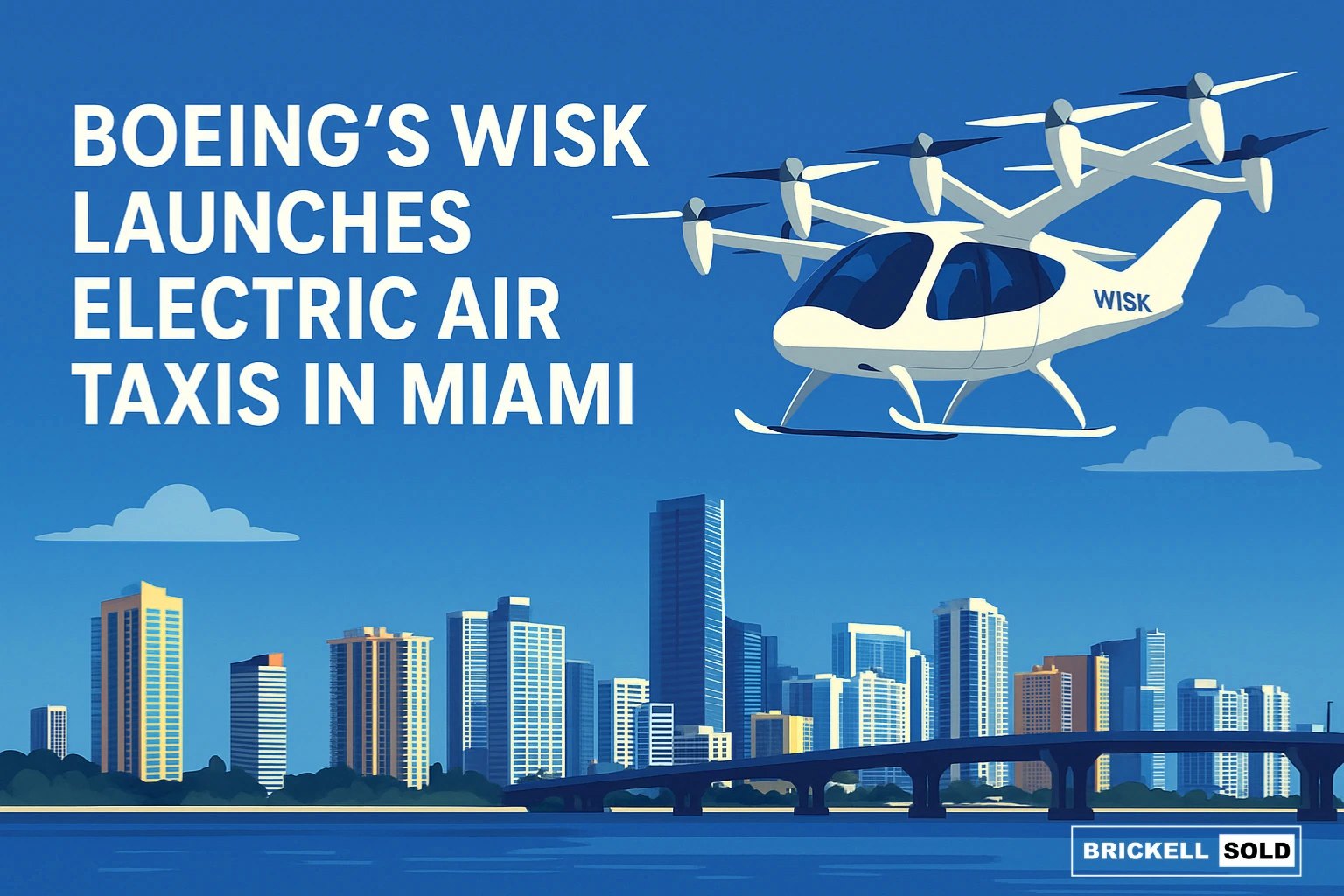
- Wisk Aero, backed by Boeing, is building local partnerships focused on vertiport design, airspace integration, electrical infrastructure, and pathways for autonomous flight.
- Vertical Aerospace is bringing its “Valo” air taxi to Miami, while targeting U.S. certification in 2028 and positioning the aircraft for urban and event travel.
- FAA approval—especially the evolving “powered-lift” framework—remains the gating factor for when passengers can actually fly.
Miami Advanced Air Mobility Timeline
– Quick Miami timeline snapshot:
– Summer (last year): UrbanLink renews partnership with VertiPorts by Atlantic Aviation to secure access to potential vertiport sites across Miami-Dade, Broward, and Palm Beach.
– June (last year): Wisk signs MOUs with Miami-Dade Aviation Department (MDAD) and University of Miami’s MEAMI to work on vertiports, airspace integration, and electrical infrastructure planning.
– Feb. 24 (this year): Vertical Aerospace schedules a Miami debut event for “Valo” at the Bass Museum/Collins Park.
– Late 2026–2027: Local operators and partners describe this as a realistic window for limited initial operations—if FAA powered-lift operations rules, aircraft certification, and vertiport/power readiness line up.
Update note: This topic moves quickly (FAA rulemaking, certification schedules, and infrastructure timelines). The dates and “first service” windows referenced here reflect publicly available information at the time of writing and may shift as programs mature.
UrbanLink Air Mobility’s All-Electric Operations
UrbanLink Air Mobility, a South Florida-based company, is positioning itself as one of the local frontrunners in the push to bring zero-emission air taxi service to Miami and the broader region.
A key step came last summer when UrbanLink renewed its partnership with VertiPorts by Atlantic Aviation. The deal gives UrbanLink access to a network of fixed-base operators and potential vertiport sites across Miami-Dade, Broward, and Palm Beach counties—an important advantage in a market where real estate, permitting, and grid upgrades can move as slowly as aircraft development.
That access matters because early vertiport planning in South Florida is leaning heavily on existing aviation footprints and partners that can support site selection and operations.
UrbanLink’s stated goal is to launch all-electric operations in the second half of 2027, timing aircraft deliveries and infrastructure buildout to the pace of FAA certification.
Steps to a 2027 Launch
Launch path (what has to happen in sequence for a 2027 start to be realistic):
1) Aircraft delivery slots confirmed → operator can finalize fleet size, training plan, and maintenance staffing.
2) Vertiport access secured (via existing FBO/airport partners) → site layouts, passenger flow, and operating hours can be designed around real constraints.
3) Electrical capacity and charging plan validated → utility coordination, transformer/feeder upgrades (if needed), and charger procurement get scheduled early.
4) Operating approvals align with FAA milestones → aircraft certification progress and operating rules determine when passenger flights can legally begin.
5) Trial operations and reliability targets met → on-time performance, noise/community feedback, and turnaround times determine whether routes can scale beyond a demo phase.
Wisk Aero’s Partnerships and Initiatives
Wisk Aero—backed by Boeing—is taking a partnership-heavy approach in Miami, aiming to prepare the ecosystem needed for autonomous, passenger-carrying eVTOL operations.
Last June, Wisk signed memoranda of understanding with the Miami-Dade Aviation Department (MDAD) and the University of Miami’s Miami Engineering and Aviation Mobility Initiative (MEAMI). The focus: vertiport design, airspace integration, electrical infrastructure planning, and the regulatory requirements needed to support self-flying aircraft.
In other words, the work is not just about aircraft—it’s about aligning airport planning, airspace management, and power needs with the certification pathway required for passenger operations.
Under the MDAD partnership, Wisk is providing technical guidance for potential vertiports at Miami International Airport, Miami Executive Airport, and Opa-locka Executive Airport—inputs intended to be incorporated into county planning, airspace management, and power needs.
The MEAMI collaboration emphasizes research and practical integration: connecting future air taxi service with existing transit networks, while also building a local talent pipeline. Wisk’s target product is a self-flying, four-passenger eVTOL—an approach that could reshape operating costs and scalability, but also raises the bar for certification and public acceptance.
Miami Partnerships Drive Operational Readiness
How the Miami partnerships translate into operational outcomes:
– MDAD (airport operator) → Vertiport design + airport procedures
– Enables: feasible pad/stand locations, passenger processing concepts, and integration with existing airport security and ground access.
– MDAD + airspace planning → Airspace integration work
– Enables: route concepts that fit around controlled airspace, arrival/departure flows, and existing traffic patterns.
– MDAD + utilities/power planning → Electrical infrastructure planning
– Enables: realistic charging power assumptions, upgrade timelines, and cost/constructability inputs before construction.
– MEAMI (university initiative) → Research + transit integration + workforce pipeline
– Enables: local testing/analysis capacity, better “first/last mile” connections, and staffing readiness as operations scale.
– Regulatory pathway focus (autonomy) → Certification and operating model clarity
– Enables: earlier identification of what evidence, procedures, and oversight will be required for self-flying passenger service.
Vertical Aerospace’s Valo and Its Market Goals
Vertical Aerospace is adding to Miami’s near-term eVTOL visibility with the “Valo,” an electric air taxi designed for up to six passengers and flights of about 100 miles.
The aircraft is scheduled to make its Miami debut at a Feb. 24 event at the Bass Museum at Collins Park, signaling how much of the early market pitch is tied to high-profile urban corridors, leisure travel, and major events—use cases where time savings can be most compelling.
Vertical Aerospace is targeting U.S. certification in 2028. The company is also developing its market strategy around partnerships, including American Airlines, as airlines and aerospace players look for a role in what could become a new short-haul layer between ground transport and traditional aviation.
| Item | What the article reports | Why it matters for Miami use cases |
|---|---|---|
| Aircraft | Vertical Aerospace “Valo” | Sets expectations for capacity and positioning versus 4-seat concepts. |
| Passenger capacity | “up to six passengers” | Higher capacity can improve per-trip economics on event/airport corridors if demand is peaky. |
| Typical mission | “flights of about 100 miles” | Fits South Florida regional hops (airport-to-city, city-to-beach, event travel) more than long-haul. |
| Miami milestone | “Miami debut at a Feb. 24 event at the Bass Museum at Collins Park” | Signals near-term market development and partner engagement, even before certification. |
| Certification target | “targeting U.S. certification in 2028” | Places it on a longer horizon than late-2026/2027 “initial ops” talk. |
| Partner example | “including American Airlines” | Suggests airline interest in feeding/connecting short trips, but still dependent on FAA approvals and infrastructure. |
FAA Approval and Its Importance for eVTOL Services
For all the prototypes, partnerships, and renderings of rooftop pads, the eVTOL industry’s critical milestone is straightforward: FAA approval for passenger service.
The FAA has been advancing rules for “powered-lift” aircraft, which cover many eVTOL designs. Industry forecasts commonly point to 2026–2028 as the likely window for initial commercial operations, reflecting both regulatory progress and the complexity of certifying new aircraft architectures, training systems, and operating procedures.
In practical terms, FAA timelines influence everything else: when manufacturers can deliver aircraft, when operators can sell tickets, and when airports and private developers can justify the cost of vertiports, charging infrastructure, and grid upgrades.
Key FAA Milestones for eVTOL Launch
FAA “gates” that typically determine when passenger eVTOL service can start (what each gate unlocks):
– Powered-lift operating rules and guidance mature → clarifies how eVTOLs can be operated day-to-day (routes, procedures, oversight).
– Aircraft type certification progresses to approval → allows a specific aircraft model to be used for commercial passenger service.
– Operator certification/authorization (air carrier/operational approvals) → allows a company to legally conduct passenger-carrying operations.
– Pilot training standards (or autonomy-related requirements) defined and accepted → determines staffing model, training pipeline, and scalability.
– Maintenance program approval + parts/support readiness → determines dispatch reliability and whether high utilization is feasible.
– Vertiport/airport approvals + safety management procedures in place → determines where aircraft can actually land, load passengers, and charge.
– Community operating constraints understood (noise, hours, routes) → determines whether service can expand beyond limited demonstrations.
Potential Vertiport Locations in Miami
Miami’s early planning is leaning on existing aviation assets while also exploring downtown and event-centric sites.
Among the locations identified in local partnerships and planning discussions are:
– Miami International Airport
– Miami Executive Airport
– Opa-locka Executive Airport
These sites offer established aviation footprints—airspace procedures, security perimeters, and operational experience—that can reduce friction compared with building entirely new facilities from scratch. At the same time, the commercial promise of air taxis depends on proximity to where riders actually want to go: dense job centers, beaches, and major venues.
Early route concepts emphasize short, high-value trips that can bypass chronic congestion—often framed as “airport-to-city” or “city-to-beach” hops, such as Brickell to South Beach.
| Candidate vertiport area | Strengths for early ops | Likely friction points / tradeoffs | Best-fit early demand |
|---|---|---|---|
| Miami International Airport (MIA) | Existing aviation security/procedures; strong airport demand; easier to integrate with airport ops | Complex airspace and traffic; passenger access/curb logistics; power upgrades may be non-trivial | Airport-to-city premium trips; business travel connections |
| Miami Executive Airport | Established general aviation footprint; potentially more scheduling flexibility than a major hub | Farther from core tourist/beach demand; ground “last mile” still needed | Suburban-to-airport or suburb-to-downtown connectors |
| Opa-locka Executive Airport | Existing aviation operations; potential room for staged buildout | Demand concentration may be less obvious than downtown/beach; airspace coordination still required | Regional connectors; overflow/event-driven demand |
| Downtown / Brickell (conceptual) | Closest to dense jobs and high-value riders; strongest time-savings narrative | Harder permitting/real estate; noise sensitivity; tighter operating constraints | Short “city-to-airport” and “city-to-beach” hops |
| Event-centric sites (conceptual) | Clear peak-demand moments; marketing visibility | Spiky demand; crowd management; temporary restrictions and neighborhood tolerance | Major events, conventions, and leisure travel surges |
The Future of Urban Air Mobility in Miami
No city has yet launched widespread commercial eVTOL passenger service, but Miami is moving in step with other major U.S. metros—Los Angeles, New York, and San Francisco among them—that are preparing networks and participating in federal pilot-style efforts.
In Miami, the near-term market is expected to skew toward high-value commuters, business travelers, and visitors willing to pay for speed and convenience—especially during peak traffic, major conventions, and marquee events. If early operations prove safe, reliable, and quiet enough to win public support, the addressable market could broaden over time.
For now, the trajectory is clear: Miami’s urban air mobility push is shifting from speculative concept to coordinated planning—driven by operator partnerships, airport involvement, and aircraft makers eager to secure one of the first viable U.S. launch markets.
Miami Early Market Expectations
What “early market” likely looks like in Miami (practical expectations):
– Start small: a limited number of routes and operating hours, often anchored at existing airports first.
– Optimize for reliability: early adoption depends less on top speed and more on consistent dispatch, predictable noise, and smooth passenger handling.
– Price for time savings: initial riders are typically time-sensitive (airport runs, business travel, event schedules) rather than everyday commuters.
– Expand only after proof: additional downtown/event sites tend to follow once operations demonstrate safety, community tolerance, and workable power/charging logistics.
From a visitor-mobility perspective, this kind of planning is worth tracking alongside ground options—especially for airport and event travel—an angle we follow at HireDriverMiami.com when covering transportation developments that could shape how people move around Miami and South Florida.
The Future of Electric Vertical Takeoff Aircraft in Urban Mobility
Innovative Technologies Driving eVTOL Development
the eVTOL race is being propelled by advances in electric propulsion, energy storage, flight controls, and increasingly sophisticated automation. The core promise is a new class of aircraft optimized for short trips: vertical takeoff and landing, lower local emissions, and routes that avoid ground bottlenecks.
But the same innovations that make eVTOLs attractive also make them hard to certify and scale. Battery performance, redundancy, thermal management, and noise profiles are not side issues—they are central to whether these aircraft can operate frequently over dense neighborhoods.
Regulatory Landscape and Its Impact on eVTOL Adoption
Regulation is not merely a hurdle; it is the market’s foundation. The FAA’s evolving framework will shape aircraft certification, pilot (or autonomous) operating requirements, maintenance standards, and how eVTOLs integrate into existing airspace.
That’s why Miami’s partnerships—especially those focused on airspace integration and regulatory pathways—matter as much as aircraft showcases. Without a clear, approved operating model, vertiports and fleets remain plans rather than services.
Infrastructure Needs for Sustainable Urban Air Mobility
Urban air mobility depends on infrastructure that is both aviation-grade and city-compatible: vertiports, passenger processing, charging systems, and reliable electrical capacity.
Miami’s strategy of anchoring early vertiports at existing airports reflects a pragmatic starting point. Yet the long-term value proposition—fast trips between the places people live, work, and visit—will require additional sites closer to demand centers, plus careful coordination with local transit and traffic patterns on the ground.
Market Dynamics and Competitive Landscape
The competitive field spans local operators, global aerospace firms, and well-capitalized startups. In Miami’s current picture:
– UrbanLink is emphasizing regional vertiport access and a 2027 operational target.
– Wisk is betting on autonomy and ecosystem readiness through institutional partnerships.
– Vertical Aerospace is marketing a higher-capacity aircraft concept for urban and event travel, with a longer certification horizon.
Nationally and globally, other eVTOL developers are also racing toward first-mover advantage, seeking the credibility—and capital access—that could come with early commercial operations.
Challenges Facing the eVTOL Industry
The industry’s challenges are structural: certification complexity, high development costs, manufacturing scale-up, battery constraints, and the “chicken-and-egg” problem of building infrastructure before demand is proven.
There is also the operational reality of urban aviation: noise sensitivity, weather disruptions, airspace constraints, and the need for consistent on-time performance if air taxis are to be more than a novelty.
The Role of Partnerships in Accelerating eVTOL Deployment
Miami’s progress underscores a broader truth: eVTOL deployment is a systems project. Aircraft makers need airports, utilities, universities, city planners, and operators aligned on design standards, power requirements, and airspace procedures.
Wisk’s agreements with MDAD and the University of Miami illustrate how companies are trying to reduce uncertainty by shaping the environment they will eventually operate in—rather than waiting for it to be built.
Public Perception and Acceptance of Air Taxis
Even if aircraft are certified, public acceptance will determine how widely eVTOLs can operate. Residents will judge the industry on safety, noise, visual impact, and whether the service feels like a practical mobility option or an exclusive amenity.
Early routes aimed at airports and event corridors may help build familiarity—provided operations are quiet, predictable, and demonstrably safe.
Environmental Considerations and Sustainability Efforts
Companies are promoting eVTOLs as “zero-emission” at the point of use, a meaningful claim in dense urban areas. The broader environmental impact will depend on electricity sources, battery supply chains, and how efficiently aircraft are operated.
If eVTOLs replace car trips in the most congested corridors—rather than simply adding a premium layer of travel—the sustainability argument becomes stronger.
Future Trends in Electric Vertical Takeoff Aircraft
The near-term trend is cautious acceleration: limited initial routes, airport-adjacent vertiports, and premium pricing aimed at time-sensitive travelers. Over time, the industry’s direction will likely hinge on three variables: certification pace, infrastructure buildout, and whether operators can achieve high utilization without compromising community tolerance.
Autonomy—if approved—could be a major inflection point, potentially lowering operating costs and expanding service frequency. But it also represents one of the most demanding regulatory and public-trust challenges in the sector.
Key eVTOL Adoption Tradeoffs
Big-picture tradeoffs that will shape whether eVTOLs feel “real” in Miami (not just impressive):
– Noise vs. access: quieter aircraft and tighter procedures help community acceptance, but may limit routes, hours, or climb profiles.
– Weather resilience vs. schedule promises: frequent storms, wind, and visibility constraints can disrupt short-hop reliability—the key selling point.
– “Zero-emission” at point of use vs. grid reality: local air quality benefits are clear, while total emissions depend on how electricity is generated and how efficiently aircraft are utilized.
– Premium pricing vs. scale: early service may be expensive; broader adoption depends on utilization, turnaround times, and (eventually) lower operating costs.
– Autonomy upside vs. certification burden: self-flying aircraft could improve economics, but requires a higher bar for regulation and public trust.
– Infrastructure speed vs. permitting/power constraints: vertiports can be designed quickly on paper, but real-world permitting, construction, and electrical upgrades often set the pace.
Market-size context: Some industry reports project very large long-term markets (for example, a Research and Markets estimate cited in 2026 coverage suggests ~$90B by 2050 and ~160,000 passenger aircraft globally). These figures are directional forecasts, not guarantees, and near-term Miami operations will likely start far smaller.
Conclusion: The Path Forward for eVTOL Companies
Miami’s eVTOL story is no longer just futuristic imagery—it is a timeline shaped by FAA milestones, airport planning, and partnerships that translate aircraft ambitions into workable routes and facilities.
If certification and infrastructure align, late 2026 through 2027 could mark the start of limited, high-value air taxi operations over South Florida. The companies that succeed will be the ones that treat urban air mobility as an integrated network—aircraft, vertiports, power, airspace, and public confidence—rather than a standalone vehicle looking for a city to land in.
This article reflects publicly available information at the time of writing about Miami-area planning signals and publicly discussed timelines for early eVTOL operations. Certification milestones, route approvals, and infrastructure schedules may shift as regulatory guidance and project plans evolve. Any long-range market forecasts mentioned are estimates, not guaranteed outcomes, and may be updated as new information emerges.