

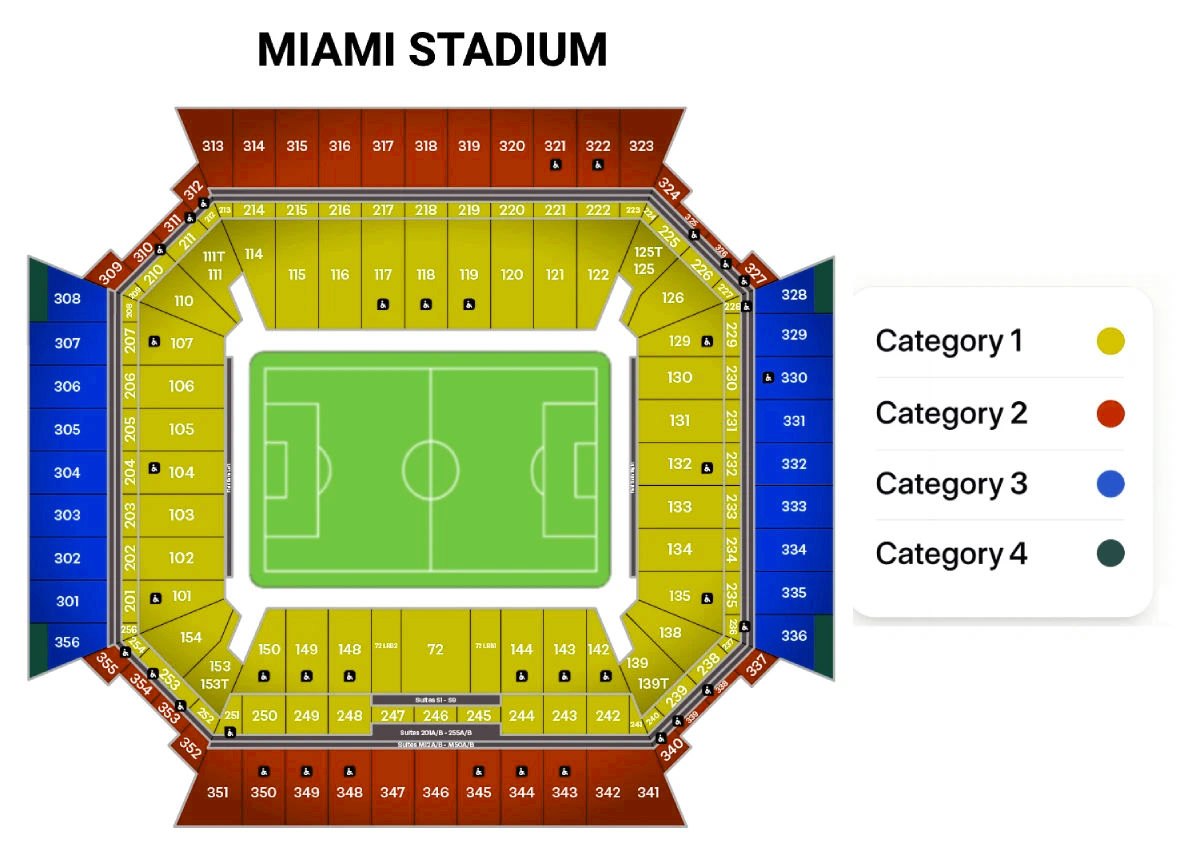
Miami to host seven matches in 2026 World Cup
- Hard Rock Stadium (branded by FIFA as “Miami Stadium”) will host seven World Cup matches in summer 2026, from the group stage through the knockout rounds.
- Miami’s slate includes four group-stage games, plus a Round of 32, a quarterfinal, and the Bronze Final (third-place match).
- Several fixtures are expected to be among the most in-demand tickets, notably Brazil vs. Scotland and the quarterfinal.
- FIFA ticketing runs through phased sales, with an official resale platform and hospitality packages offering premium access.
Overview of the 2026 FIFA World Cup in Miami
In the summer of 2026, Miami will become something more than a host city. Around Hard Rock Stadium in Miami Gardens, the familiar rhythms of South Florida—tailgates, weekend traffic, and stadium crowds—will be overlaid by something unmistakably global: national team jerseys replacing beachwear, flags draped where parking-lot tents usually stand, and a mix of accents that turns a matchday walk into a moving crossroads.
Hard Rock Stadium—temporarily known to FIFA as Miami Stadium—is scheduled to stage seven matches across the tournament’s five-week run. That span matters. Miami is not limited to early group-stage fixtures; it also hosts games where the stakes sharpen: a Round of 32 match, a quarterfinal, and the Bronze Final. In practical terms, that means Miami will see both the tournament’s opening narratives and some of its most consequential turning points.
The 2026 FIFA World Cup itself is set to be the largest edition to date, with 48 teams playing 104 matches across 16 host cities in the United States, Canada, and Mexico. Miami’s role fits the broader theme of expansion and reach: established powers and emerging nations sharing the same stage, often on neutral ground, in a city already accustomed to being an international meeting point.
For fans, Miami’s schedule offers a rare mix: named group-stage matchups you can plan around now, and later-round fixtures where the teams will only be known once the tournament unfolds—yet the atmosphere and consequence are guaranteed.
Match Schedule at Hard Rock Stadium
Miami’s slate is spread across the group stage and the tournament’s later rounds, with kickoff times that lean into evening football in South Florida. The schedule begins mid-June and runs through mid-July, culminating with the Bronze Final—Miami’s last chance to host the World Cup in 2026, and one of the tournament’s final showcase events.
What makes this lineup distinctive is the arc: Miami opens with a group-stage contrast in styles and reputations, then returns to host matchups that reflect the tournament’s expanded global footprint. By late June, the city gets a culturally charged fixture expected to be among the most sought-after tickets. And by July, Miami is hosting matches where a single mistake can end a campaign.
Below is the full list of matches scheduled for Hard Rock Stadium (Miami Stadium) during the 2026 FIFA World Cup.
Group Stage Matches
Miami will host four group-stage matches, all at Hard Rock Stadium in Miami Gardens:
- Match 13: Saudi Arabia vs. Uruguay — June 15, 2026, 6 PM ET
- Match 37: Uruguay vs. Cape Verde — June 21, 2026, 6 PM ET
- Match 49: Scotland vs. Brazil — June 24, 2026, 6 PM ET
- Match 71: Colombia vs. Portugal — June 27, 2026, 7:30 PM ET
The group-stage run is designed to build momentum. Miami’s opener is positioned as the city’s first taste of the tournament, and it’s expected to draw strong international demand—particularly from traveling supporters. The later group games, especially Brazil vs. Scotland, are the kind of fixtures that can turn a stadium into a cultural event as much as a sporting one.
Knockout Stage Matches
Miami’s knockout-round hosting duties include three matches, each with a different kind of pressure:
- Match 86: Winner Group J vs. Runner-up Group H — July 3, 2026, 6 PM ET (Round of 32)
- Match 99: Quarterfinal — July 11, 2026, 5 PM ET
- Match 103: Bronze Final (Third Place Match) — July 18, 2026, 5 PM ET
The Round of 32 match is where the tournament’s margins narrow—advance or exit, with no second chances. The quarterfinal is widely viewed as one of the World Cup’s defining stages, where tournaments pivot and careers can be made. And the Bronze Final carries its own emotional complexity: pride, recovery, and legacy for teams that fell just short of the final, played in front of a crowd that knows it’s the last World Cup match Miami will host in 2026.
Key Matches to Watch
Miami’s schedule is strong on paper, but a few fixtures stand out for what they represent: contrasts in footballing identity, cultural weight, and the kind of tournament tension that can turn a match into a memory.
Three group-stage games in particular are likely to shape the city’s World Cup story. One is Miami’s opener, where first impressions—of the stadium, the crowd, and the tournament’s energy—will be set. Another is a heavyweight meeting expected to be among the most sought-after tickets in Miami’s slate. And the final one arrives late in the group stage, when standings and knockout paths may already be taking shape, adding urgency to every decision on the pitch.
These are not the only matches that will matter—Miami’s quarterfinal, for instance, is expected to be among the highest-demand tickets of the entire tournament—but the following three group-stage fixtures are the ones most likely to define the city’s early World Cup atmosphere.
Saudi Arabia vs. Uruguay
Saudi Arabia vs. Uruguay on June 15, 2026 (6 PM ET) is Miami’s first World Cup match of the tournament, and it arrives with a built-in narrative contrast.
Saudi Arabia comes in as a side shaped by recent investment and growing ambition, a team that signals how the global game is evolving and where resources and attention are flowing. Uruguay, by contrast, brings a long-established international pedigree, with a reputation built on discipline and tournament resilience—traits that tend to matter when the pressure rises and the margins get thin.
As the opening match in Miami, this fixture is expected to draw strong international demand, particularly from traveling supporters. That matters for fans deciding which game to prioritize: openers have a different energy. They’re less about scoreboard watching and more about the first surge of tournament emotion—chants that start early, flags everywhere, and the sense that the World Cup has truly arrived in the city.
For Miami Gardens and Hard Rock Stadium, it’s also a tone-setter. The first match is where logistics, crowd flow, and the stadium’s World Cup identity are tested in real time. For supporters, it’s the first chance to experience the “global crossroads” feeling Miami is expected to embody throughout the tournament.
Brazil vs. Scotland
Few group-stage fixtures in Miami carry the same cultural weight as Brazil vs. Scotland on June 24, 2026 (6 PM ET).
Brazil arrives with history, expectation, and global attention—a team that rarely plays a quiet match at a World Cup, because the jersey itself carries a kind of worldwide spotlight. Scotland arrives with something different but equally powerful: a fiercely loyal fan base known for turning stadiums into what can feel like a continuous soundtrack.
That combination—Brazil’s global magnetism and Scotland’s traveling support—helps explain why this match is expected to be in high demand in Miami’s World Cup slate. Even for neutral fans, it’s the kind of pairing that promises atmosphere: a crowd split into distinct colors and rhythms, with the match itself likely to be played at a tempo that keeps the stadium engaged.
From a planning perspective, this is also the kind of game where demand can shape everything around it: ticket availability, resale pricing pressure, and the need to lock in travel and transportation early. If you’re choosing one group-stage match in Miami to build a trip around, this is the obvious candidate—precisely because so many other people will be thinking the same thing.
Colombia vs. Portugal
Miami’s final group-stage match, Colombia vs. Portugal on June 27, 2026 (7:30 PM ET), has the advantage of timing: late enough in the group stage that the table may already be shaping the tournament’s next chapter.
Colombia is framed by an expressive, attacking tradition, while Portugal brings tactical precision and tournament experience. That stylistic contrast can make for a compelling match even before the stakes are known. But by this point in the schedule, the stakes often reveal themselves quickly: a draw that isn’t enough, a goal difference that suddenly matters, or a scenario where a single moment changes a knockout path.
That’s what makes late group-stage games so tense. The crowd isn’t just reacting to what’s happening in Miami; it’s often tracking what’s happening elsewhere, too, because group standings can hinge on multiple results. Even without inventing scenarios, the basic reality holds: by the final group match, urgency tends to rise.
For Miami, it’s also the last chance to see named, marquee national teams in the group stage before the tournament shifts into its elimination identity—where matchups are determined by results and the emotional tone changes from celebration to survival.
Ticketing Information for Miami Matches
World Cup tickets are rarely simple, and 2026 is designed to be no exception. FIFA has used a structured, multi-phase process intended to manage demand and distribute access across different windows—some based on random selection, some based on speed, and some tied to premium products.
For Miami matches, the key is understanding what is “official,” what is “available,” and what is “likely.” Official channels include FIFA’s ticketing phases, the official resale platform, and FIFA hospitality packages. Beyond that, the broader resale market exists, but it often comes with higher prices than face value.
Another factor shaping the experience is pricing itself. FIFA is using dynamic pricing, meaning prices can fluctuate based on demand and timing. That doesn’t mean every fan will pay the same amount for the same match category at every moment; it means planning and timing can affect what you end up paying.
Below is what’s known about sales phases and pricing categories for the 2026 World Cup, with Miami-specific context where available.
Source note: This guide summarizes publicly available reporting and fan resources (including Miami Living Magazine and ticketing/travel guides) and should be cross-checked against FIFA’s official ticketing updates as they change.
Sales Phases
FIFA’s ticketing process has been organized into multiple phases:
- Visa Presale Draw: Ran September 10–19, 2025, exclusive to Visa cardholders. Successful applicants received purchase time slots beginning October 1, 2025.
- Early Ticket Draw: Ran October 27–31, 2025, using a randomized selection that assigned successful applicants time slots to buy.
- Random Selection Draw: Opened December 11, 2025 after the tournament’s Final Draw, allowing fans to apply for specific matches once group-stage matchups were determined. The application window closed January 13, 2026, with results expected in February.
- First-Come, First-Served Sales: Any remaining tickets are expected to be sold closer to the tournament, with this phase expected to open in mid-2026.
In addition, FIFA operates an official resale platform, where fans can list tickets they can no longer use and other fans can purchase them. The advantage is legitimacy and compliance; the limitation is obvious: availability depends entirely on what other fans decide to list.
Ticket-safety note: For legitimacy, prioritize FIFA’s official ticketing channels and the official resale marketplace before considering any third-party resale options.
For fans targeting Miami’s most in-demand fixtures—especially Brazil vs. Scotland and the quarterfinal—the practical implication is that you may need to try more than one pathway: apply in draws when available, monitor official resale, and be ready for first-come sales if inventory appears.
Pricing Categories
FIFA ticket prices are organized by categories, and for 2026 they are subject to dynamic pricing—so the figures below are best understood as listed price points rather than guarantees that never move.
Group Stage (Miami group matches):
– Category 1: $445
– Category 2: $335–$385
– Category 3: $155
– Category 4: $60–$75
Knockout rounds in Miami:
– Round of 32
– Category 1: $505
– Category 2: $405
– Category 3: $175
– Category 4: $135
– Quarterfinal
– Category 1: $1,375
– Category 2: $955
– Category 3: $635
– Category 4: $295
– Bronze Final (Third Place Match)
– Category 1: $1,070
– Category 2: $825
– Category 3: $395
– Category 4: $165
On the broader resale market (outside FIFA’s official resale platform), prices are often higher than face value. Examples cited include group-stage tickets starting around $500, with knockout-round tickets potentially exceeding $1,000—a reflection of demand rather than an official benchmark.
Travel and Logistics for Attendees
Hard Rock Stadium sits in Miami Gardens, and for many visitors the first logistical question is distance: the venue is about 18 miles from Miami International Airport (MIA). That’s close enough to feel manageable, but far enough that traffic patterns and timing can shape your entire matchday.
For World Cup matches—especially those with high demand—planning transportation becomes part of the ticket strategy. A seat in the stadium is only as good as your ability to arrive on time and leave without turning the night into an endurance test.
The good news is that Miami has multiple ways to reach the stadium area, including rideshare and public transit connections. The challenge is that matchdays compress demand into a narrow window: thousands of people trying to arrive within the same hour or two, and then leaving at once.
Below are the core options and what’s known about parking for the venue during the tournament.
Getting to Hard Rock Stadium
Hard Rock Stadium is reachable by several common routes:
- Rideshare (Uber/Lyft): Widely available in Miami, with typical travel times from MIA ranging from 25 to 40 minutes, depending on traffic. On matchdays, that “depending on traffic” becomes the key variable—especially around kickoff windows.
- Public transport: Miami’s Metrorail and Metrobus networks connect central Miami to shuttle hubs near the stadium. Special event shuttles are expected to operate during the tournament.
For visitors staying in central Miami, the combination of rail/bus plus shuttles can be a way to reduce the stress of driving and parking. For others—especially groups—rideshare can be the simplest door-to-door option, though it’s still subject to congestion.
The most important planning principle is time. Evening kickoffs (many Miami matches are scheduled at 6 PM ET, with one at 7:30 PM ET) can coincide with heavy traffic periods. Building in buffer time isn’t just cautious; it’s realistic.
Parking Options
Hard Rock Stadium typically offers about 24,000 parking spaces, but that capacity is expected to be reduced during the World Cup. That reduction matters: fewer spaces, more demand, and a higher likelihood that parking becomes a bottleneck if you treat it as an afterthought.
Parking costs have been cited in a range of $55 to $119 per vehicle, and pre-booking is strongly recommended. For fans who plan to drive, the combination of reduced availability and high demand makes advance planning less of a convenience and more of a necessity.
Even with a prepaid spot, matchday traffic around the stadium can be heavy. The tradeoff is straightforward:
- Driving offers control over your schedule and can be cost-effective for groups.
- But it also ties you to the stadium’s traffic patterns before and after the match, when thousands of cars are trying to move at once.
If you’re choosing between driving and alternative transport, consider the match you’re attending. High-demand fixtures and later-round games are more likely to bring larger crowds and tighter logistics—conditions where parking pressure tends to rise.
Hospitality Packages and Premium Experiences
For fans who want a more predictable path into the stadium—or who simply want to turn a World Cup match into a full-scale event—FIFA’s hospitality offerings are the most direct option.
Hospitality packages are positioned as a way to secure guaranteed access along with premium amenities. Packages have been listed as starting at $1,350 per person, and can include elements such as premium seating, food, lounge access, and other exclusive features. They are available through FIFA’s official channels, including FIFA.com/tickets and FIFA’s hospitality site.
The appeal is less about bargain pricing and more about certainty and comfort. In a tournament where many tickets are distributed through draws, and where high-demand matches can become difficult to secure, hospitality is a way to bypass some of the uncertainty—at a cost.
For Miami specifically, hospitality may be particularly attractive for:
- Fans targeting the quarterfinal, which is expected to be among the highest-demand matches of the entire tournament.
- Visitors traveling internationally who want to lock in a match experience without relying on later sales phases or resale availability.
- Groups and corporate travelers who value lounge access and bundled services as part of the day.
It’s also worth noting that Miami’s matchday environment—heat, crowds, and the scale of the event—can make premium spaces feel less like an indulgence and more like a practical upgrade for some attendees.
Hospitality won’t be the right fit for every budget, but in a World Cup hosted across three countries and 16 cities, it remains one of the clearest “pay for certainty” options available.
Tips for Securing Your Tickets
Getting into a World Cup match is often less about a single purchase and more about a strategy—especially in a city hosting fixtures expected to draw international demand.
Here are practical steps grounded in how FIFA’s process works and how Miami’s match slate is likely to behave:
-
Create and maintain your FIFA ticketing access early. The core requirement across phases is having a FIFA ID and being ready when application windows open. If you wait until a phase is live, you’re already behind.
-
Use the phases the way they’re designed. FIFA’s system includes multiple pathways—draws, later first-come sales, and official resale. If you only try one, you’re limiting your odds. Apply during draw windows when available, then stay alert for subsequent opportunities.
-
Be flexible about matches if your priority is “any Miami game.” Miami has seven matches, including group-stage fixtures that may be less in demand than Brazil vs. Scotland or the quarterfinal. Flexibility can increase your chances of landing seats.
-
Monitor FIFA’s official resale platform. It’s designed to ensure legitimacy and compliance. The catch is that inventory depends on other fans listing tickets, so it rewards persistence and frequent checking.
-
Understand dynamic pricing—and plan accordingly. With dynamic pricing, timing and demand can influence what you pay. If you’re targeting a marquee match, assume demand will be high and that waiting may not improve affordability.
-
Treat unofficial resale prices as a separate market. Tickets on platforms like StubHub and SeatGeek have been cited as often exceeding face value, with group-stage tickets sometimes starting around $500 and knockout tickets potentially exceeding $1,000. That doesn’t mean you can’t find seats—but it does mean budgeting realistically.
-
Consider hospitality if certainty matters more than price. FIFA hospitality packages starting at $1,350 per person can be a direct route to premium seating and amenities, especially for high-demand games.
In short: the best approach is layered—apply early, stay flexible, use official channels, and decide in advance how much certainty is worth to you.
Conclusion and Final Thoughts
Miami’s 2026 World Cup schedule is built like a story: it begins with a group-stage opener that sets the city’s tone, builds through culturally charged matchups, and then returns in July with games where the tournament’s pressure is unmistakable. That means Miami won’t just “touch” the World Cup. It will host it across multiple phases of the competition, including a quarterfinal and the Bronze Final.
For fans, the opportunity is obvious and rare. But so are the challenges: phased ticket sales, dynamic pricing, and the reality that the most desirable fixtures—Brazil vs. Scotland, the quarterfinal—will attract intense demand. The smartest planning starts with understanding the official pathways: FIFA’s sales phases, the official resale platform, and hospitality options for those who want guaranteed access.
Then comes the practical layer: getting to Miami Gardens, managing traffic, and deciding whether parking, rideshare, or public transit connections make the most sense for your matchday. With reduced parking capacity expected during the World Cup and parking prices cited from $55 to $119, logistics can quickly become part of the cost of attendance.
Ultimately, Miami’s World Cup will be more than a set of kickoffs. It will be a convergence—of teams, supporters, and identities—in a city built for international overlap. The fans who get the most out of it will be the ones who plan early, stay flexible, and treat the ticket hunt as part of the event itself.
Embrace the Cultural Melting Pot
Miami’s World Cup matches are set to feel like a compressed version of the tournament’s global promise: flags, languages, and fan traditions sharing the same sidewalks outside Hard Rock Stadium. The group-stage slate alone—Saudi Arabia, Uruguay, Cape Verde, Scotland, Brazil, Colombia, Portugal—signals how varied the matchday crowd is likely to be.
That atmosphere is part of what you’re buying when you buy a ticket. Even before kickoff, the experience is in the overlap: supporters arriving in clusters, songs and chants competing in the concourses, and the sense that Miami Gardens has temporarily become neutral ground for the world’s game.
If you’re traveling in, lean into that. Arrive early enough to absorb the pre-match energy, because the World Cup isn’t only the 90 minutes—it’s the hours around it when the city feels like a crossroads.
Plan Ahead for a Seamless Experience
The most predictable way to reduce stress is to plan the basics earlier than you think you need to. Miami’s matches include high-demand fixtures and late-round games, and that demand will show up not only in ticket availability but also in transportation and parking pressure.
Hard Rock Stadium is about 18 miles from MIA, rideshare times can range from 25 to 40 minutes depending on traffic, and parking capacity is expected to be reduced during the tournament. Those are manageable facts—if you build your day around them.
Whether you’re relying on FIFA ticket phases, monitoring the official resale platform, or considering hospitality for guaranteed access, the same principle applies: the earlier you commit to a plan, the more options you keep. The World Cup will bring spontaneity on the pitch. Off it, Miami will reward preparation.
Scope note: This article is published by HireDriverMiami.com, a Miami/South Florida transportation service and local news blog. It’s intended as a planning overview for visitors; for the latest ticket rules, availability, and resale policies, always confirm details directly through FIFA’s official ticketing channels.