

Table of Contents
- The Birth of Apocalypse BBQ
- From Backyard Passion to Restaurant Success
- The Unique Miami-Style Barbecue Experience
- Cultural Influences in Apocalypse BBQ’s Menu
- Jeff Bud’s Philosophy on Community and Food
- Challenges Overcome: Jeff Bud’s Personal Journey
- Insights from The Making Miami Podcast
- Future Aspirations for Apocalypse BBQ
- Exploring the Future of Miami BBQ
- Innovative Trends in Barbecue
- Community Engagement and Culinary Growth
Miami’s food identity has long been defined by fusion—Caribbean, Latin American, Southern, and global influences colliding in a city that rarely sits still. In Kendall, Apocalypse BBQ has become one of the clearest expressions of that energy: a barbecue restaurant built on classic low-and-slow technique, then pushed through a distinctly Miami lens.
Jeff Bud’s journey transforms Miami’s BBQ scene
The Birth of Apocalypse BBQ
Born During the Pandemic Era
– When it started: During the COVID-19 pandemic, after pandemic disruption pushed Bud back toward cooking and community.
– Why the name stuck: “Apocalypse” functions as a time marker for the era it was born in—not a themed concept.
– How it spread: Backyard cooks → word-of-mouth momentum → demand that outgrew the informal setup.
– Freshness cue: The story is still recent—coverage describes the concept as growing rapidly in the years since its pandemic start (as reported in local outlets including CBS Miami and the Boca Raton Observer).
From Backyard Passion to Restaurant Success
What started at home evolved into pop-ups and a food-truck phase before landing in a permanent space at Kendall Village Shopping Center. Today, Apocalypse BBQ operates as a 190-seat restaurant, a scale that signals both demand and operational maturity—especially in a category where consistency is hard-won and time is the main ingredient.
The growth has been rapid, but not accidental: Bud’s approach pairs craft barbecue fundamentals with a menu designed for Miami’s palate, not a copy-and-paste of Texas or the Carolinas.
From Backyard to Restaurant
1) Backyard phase (proof-of-product): Dial in core meats and repeatable cooks before adding volume.
– Checkpoint: Can you hit the same brisket texture and seasoning profile cook after cook?
2) Pop-ups (proof-of-demand): Test lines, pacing, and what sells out first.
– Checkpoint: Do you know your “sell-out” items and how early they run out?
3) Food truck (proof-of-operations): Tight menu, tight timing, real service pressure.
– Checkpoint: Can the team execute under constraints (space, prep, holding) without quality drift?
4) Permanent location (proof-of-scale): Kendall Village Shopping Center → a 190-seat dining room.
– Checkpoint: Can you keep smoke management, timing, and staffing consistent at restaurant volume?
The Unique Miami-Style Barbecue Experience
Apocalypse BBQ’s calling card is “Miami-style” barbecue—food that respects traditional smoking methods while embracing the city’s flavors and habits. Brisket is still brisket, but it shares the table with cafecito-forward rubs, tropical heat, and sides that feel native to South Florida.
Among the restaurant’s most talked-about items:
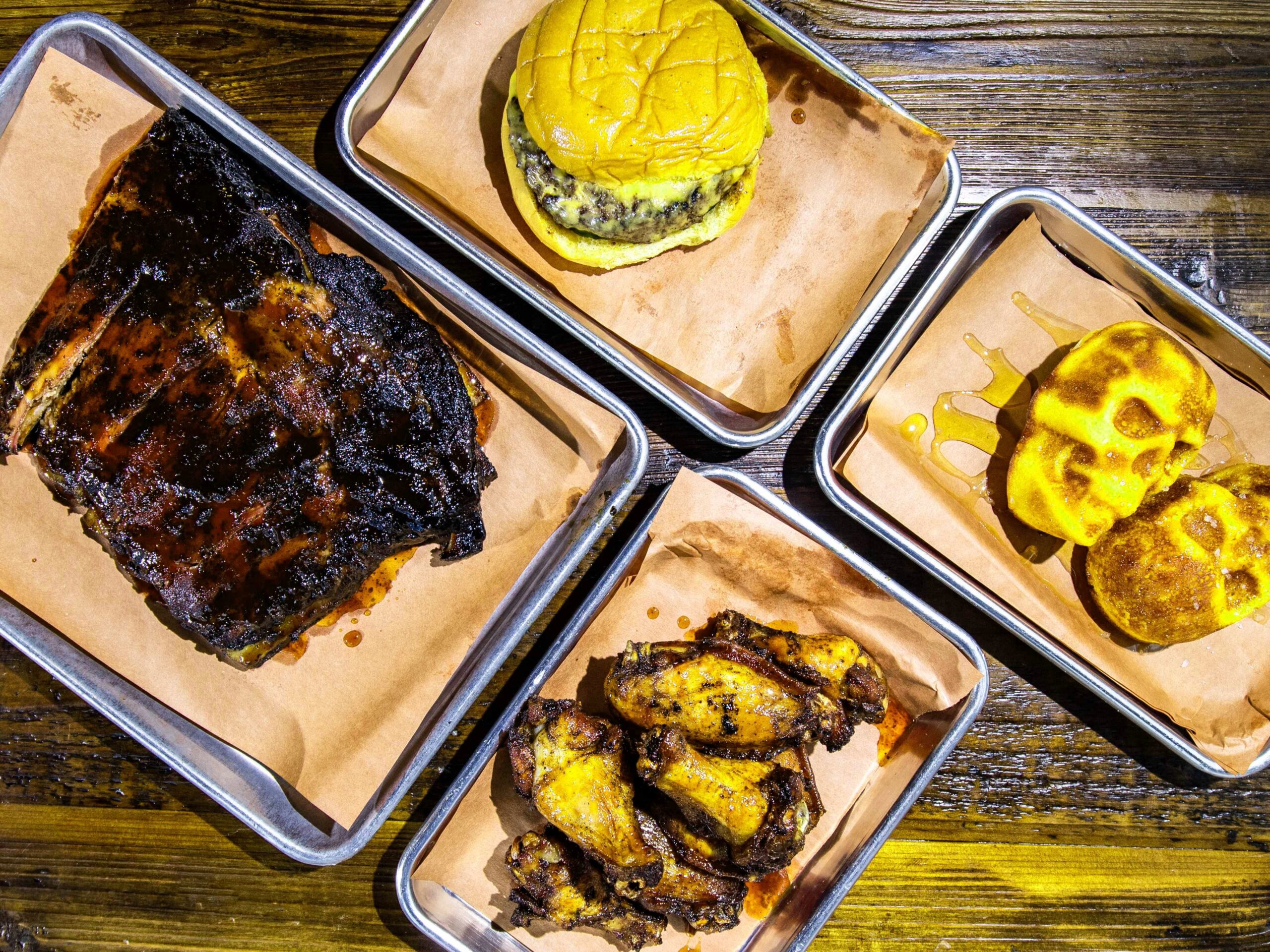
- Kitchen Sink Platter, built around slow-smoked meats including brisket cooked for about 14 hours, plus ribs and pork belly burnt ends.
- Smokafried Wings, seasoned with a cafecito rub, smoked, fried, then finished with Oro Negro sauce—a direct nod to Miami’s coffee culture.
- Smoked maduros, a sweet-savory riff on fried plantains, finished with smoke.
- Skull-shaped cornbread, a playful signature that doubles as comfort food.
Sauces also carry the concept: options such as Carolina Mojo, Mango Habanero, and Cowboy Butter bridge barbecue tradition with Miami’s citrus, spice, and brightness.
| Signature item | Technique cue | Miami flavor cue | Reported by (per dossier) |
|---|---|---|---|
| Kitchen Sink Platter | Low-and-slow smoking; brisket ~14 hours | Big, shareable “party platter” energy; coffee-forward rubs show up across the menu | Boca Raton Observer; CBS Miami |
| Smokafried Wings | Smoked → fried → sauced | Cafecito rub + Oro Negro sauce (coffee culture) | Boca Raton Observer |
| Smoked maduros | Fried plantains finished with smoke | Latin side staple reworked with pit flavor | Boca Raton Observer |
| Skull-shaped cornbread | Baked side | Playful presentation; comfort-food sweetness | Boca Raton Observer |
| Carolina Mojo / Mango Habanero / Cowboy Butter | Sauce program | Citrus + tropical heat + richness (Miami brightness) | WSFL-TV |
Cultural Influences in Apocalypse BBQ’s Menu
Bud has been explicit about the restaurant’s cultural intent: the food should reflect the 305. That means Latin flavors aren’t treated as “specials” or side notes—they’re integrated into the core identity of the menu, from coffee-rubbed meats to mojo-inspired sauces.
In a city where diners often expect bold seasoning and layered acidity, Apocalypse BBQ’s success suggests a broader truth: Miami doesn’t need to import barbecue culture wholesale. It can remix it—and make it feel local.
Understanding Miami-Style BBQ
A simple way to understand “Miami-style BBQ” on this menu
1) BBQ base (the non-negotiables): classic smoking technique, time, and meat fundamentals.
2) 305 flavor system (the local layer): cafecito/coffee notes, mojo-style citrus/garlic, tropical heat (e.g., mango + habanero).
3) Integration test (what makes it feel authentic): the Miami layer shows up in rubs, sauces, and sides—not as a one-off garnish.
As Bud put it in a TV interview: “We’re about that 305 culture. We have to infuse ourselves, our Miami culture, into the food we make.” (Jeff Bud, quoted by WSFL-TV)
Jeff Bud’s Philosophy on Community and Food
Apocalypse BBQ sells barbecue, but Bud frames the mission in human terms. He has described the restaurant as a place built for life’s milestones—first dates, proposals, family meals—an idea that positions the dining room as community infrastructure, not just a service counter.
That ethos shows up in the atmosphere as well, including vinyl records spinning on turntables, reinforcing a sense of warmth and personality rather than a purely transactional experience.
Community-First Hospitality Vision
Two lines that capture Bud’s community-first intent (as reported in local coverage):
– “We’re not in the food business; we’re in the love business.” (Jeff Bud, quoted by CBS Miami)
– “We want this to be a spot where you’re coming here, you’re coming on your first date, then you’re coming to propose, and then you’re coming when you’re married, and then you’re bringing your kids.” (Jeff Bud, quoted by CBS Miami)
Challenges Overcome: Jeff Bud’s Personal Journey
Bud’s relationship with barbecue is also rooted in survival. At 22, he was diagnosed with acute myeloid leukemia, and the restrictions of a compromised immune system pushed him away from restaurants and toward learning to cook for himself. He has recounted deciding to master barbecue at home rather than give it up—an origin story that reframes the craft as both comfort and determination.
That personal history now sits behind a public-facing brand, but it helps explain the intensity: barbecue is time-consuming, unforgiving, and repetitive by nature. People rarely commit to it at scale without a deeper reason.
Resilience Through Barbecue Craft
Challenge → adaptation → outcome (as described in coverage)
– Challenge: At 22, Bud faced acute myeloid leukemia and had to avoid restaurants due to immune risk.
– Adaptation: He taught himself to cook barbecue at home—captured in his reported mindset: “I might die, and if I’m gonna die, it’s not gonna be without eating more barbecue, so I’m gonna learn how to make it.” (Jeff Bud, quoted by CBS Miami)
– Outcome: The skill became a long-term craft and, later, the foundation for a public-facing restaurant built around resilience and repetition.
Insights from The Making Miami Podcast
Bud’s recent conversation with Josephine Novo on The Making Miami Podcast centered on the arc from early experimentation to a full restaurant—and on the broader question of what it means to “make” something in Miami’s fast-moving economy.
Key themes from the discussion include:
Apocalypse BBQ: Resilience and Growth
What this episode adds (based on the Miami Community Newspapers write-up of the conversation):
– [ ] Who’s speaking: Jeff Bud (Apocalypse BBQ) in conversation with host Josephine Novo.
– [ ] What the conversation focuses on: Jeff’s background, Apocalypse BBQ’s evolution, and his other food-industry projects.
– [ ] What to listen for: how he connects (1) personal resilience, (2) Miami cultural identity on the plate, and (3) growth plans without losing the core.
– [ ] Where it’s published: Miami Community Newspapers / CNewsTV (episode page linked in the dossier).
Future Aspirations for Apocalypse BBQ
Apocalypse BBQ’s trajectory points toward expansion—of the brand, the reach, and the influence of “Miami-style” barbecue as a recognizable category. Bud has signaled interest in growing while keeping the restaurant’s core intact: quality, creativity, and a sense of place.
In a market where hype can outpace execution, the next chapter will likely hinge on whether Apocalypse can scale without losing the details—smoke management, timing, and the cultural specificity that makes the menu feel like Miami rather than barbecue-by-numbers.
Scaling Without Losing Consistency
If Apocalypse BBQ expands, the tension to manage is straightforward:
– More seats/locations → more access and brand reach
– Tradeoff: harder to keep pit timing, smoke consistency, and training identical across shifts/teams.
– Bigger menu and higher volume → more reasons to visit
– Tradeoff: higher risk of “good on a slow day, inconsistent on a busy day.”
– Wider audience → more visibility for “Miami-style BBQ”
– Tradeoff: pressure to smooth out the very cultural specifics (cafecito, mojo, tropical heat) that make it feel like the 305.
Exploring the Future of Miami BBQ
Innovative Trends in Barbecue
Miami barbecue is increasingly defined by hybridization: traditional smoking techniques paired with local flavor systems—coffee, citrus, tropical heat, and Latin staples. Apocalypse BBQ sits near the front of that movement, showing how a city better known for stone crab and Cuban sandwiches can still claim a barbecue identity without imitation.
Community Engagement and Culinary Growth
If Miami’s next wave of barbecue is going to matter, it will be because it becomes communal—restaurants that function as gathering places, not just destinations. Apocalypse BBQ’s rise in Kendall suggests that neighborhood loyalty, cultural fluency, and a clear point of view can turn a pandemic-born project into a lasting part of the city’s food map.
Miami BBQ’s Next Direction
A quick way to read where Miami BBQ is headed (using Apocalypse BBQ as a reference point):
1) Technique rigor: the city rewards creativity, but barbecue still lives or dies on repeatable cooks.
2) Hybrid flavor identity: Miami’s strongest BBQ tends to pair smoke with local anchors (coffee, citrus/garlic mojo, tropical heat).
3) Neighborhood gravity: concepts that become “our spot” (not just a tourist stop) build staying power.
4) Atmosphere as culture: the room matters—music, vibe, and hospitality become part of the food’s identity.
This piece is part of HireDriverMiami.com’s Miami-focused coverage for visitors and new residents, highlighting local food and culture alongside practical transportation planning across South Florida.