

Table of Contents
- 1. The Coconut Grove Art Fair 2026 took place in
- 2. Overview of the Coconut Grove Art Fair 2026
- 3. Celebrating Miami’s Creative Spirit
- 4. Featured Artists and Their Works
- 4.1 Jenny Henley’s Unique Blends of Photography and Painting
- 4.2 Agnes Rathonyi’s Exploration of Texture and Color
- 4.3 Benjamin Frey’s Architectural Mixed-Media Drawings
- 4.4 Unmarid Eitharong’s Dynamic Abstract Works
- 5. Community Engagement at the Fair
- 6. Culinary Delights and Entertainment
- 7. The Fair’s Impact on Local Culture and Economy
- 8. Conclusion: The Importance of Art in Miami
- 9. The Essence of Coconut Grove Art Fair 2026
- 9.1 A Celebration of Artistic Diversity
The Coconut Grove Art Fair 2026 took place in
- Presidents’ Day weekend, Feb. 14–16, 2026, along Coconut Grove’s waterfront streets in Miami
- Nearly 300 jury-selected artists showed work across painting, photography, sculpture, mixed media, jewelry, and more
- Standout booths ranged from nostalgic tech-inspired pigment prints to glass-framed abstractions with 3D depth
- Food, music, and family-friendly activities helped turn the fair into a neighborhood reunion as much as an art event
Presidents’ Day Waterfront Festival Details
– When: Presidents’ Day weekend (Feb. 14–16, 2026)
– Where: Coconut Grove waterfront streets — McFarlane Road, South Bayshore Drive, and Pan American Drive
– Nearby anchor: The festival footprint centers around the Grove’s waterfront/park area along Biscayne Bay
– Typical daily timing (as publicly listed for the 2026 edition): daytime hours across all three days (with a slightly earlier close on Monday)
Coverage perspective: This guide was prepared for visitors and newcomers planning time in Miami, drawing on local event reporting and the travel-and-getting-around focus of HireDriverMiami.com’s Miami-area blog.
Overview of the Coconut Grove Art Fair 2026
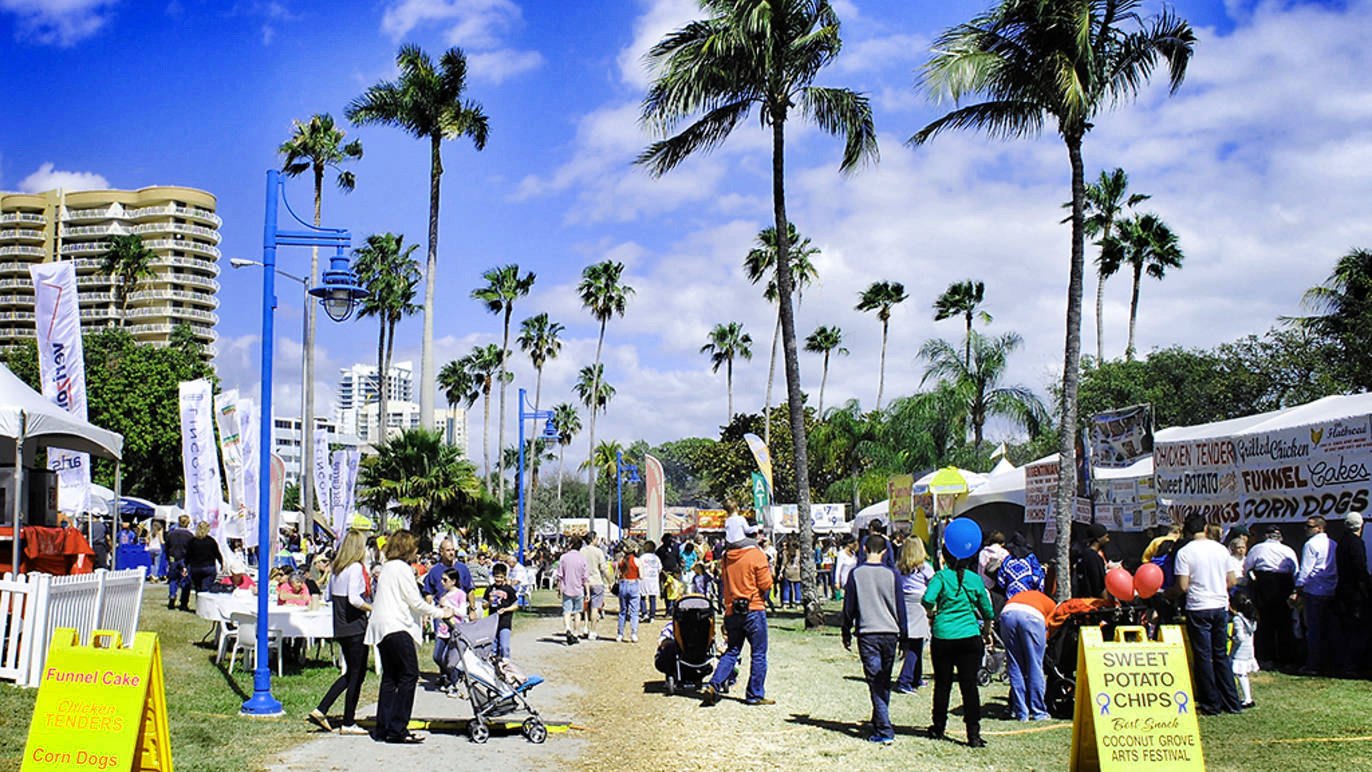
The Coconut Grove Art Fair 2026—widely known as the Coconut Grove Arts Festival—returned as a marquee outdoor arts event, drawing crowds to the shaded, waterfront corridors of McFarlane Road, South Bayshore Drive, and Pan American Drive.
With a legacy spanning decades, the festival has grown alongside Miami’s rise as a global arts destination. Managed by the nonprofit Coconut Grove Arts & Historical Association, the 2026 edition underscored that evolution: a large, juried field of artists and a steady flow of collectors and families.
Flagship Waterfront Art Weekend
– Scale (commonly reported for the 2026 edition): nearly 300 jury-selected artists across a wide range of mediums.
– Setting: an outdoor, waterfront route along McFarlane Rd, South Bayshore Dr, and Pan American Dr, which is a big part of the fair’s “walkable neighborhood” feel.
– Organizer context: the event is managed by the nonprofit Coconut Grove Arts & Historical Association, and the fair is frequently described as one of Miami’s long-running, flagship outdoor art weekends.
Celebrating Miami’s Creative Spirit
What distinguishes Coconut Grove’s signature art weekend is its sense of place. Beneath the trees and beside Biscayne Bay, the fair plays out as a living snapshot of Miami—international in its influences, local in its pride, and open in its conversations.
Visitors moved booth to booth not just to browse, but to talk: about process, materials, memory, and the city itself. The result was a festival that felt less like a marketplace and more like a public square—where Miami’s creative identity is performed in real time.
Featured Artists and Their Works
Jenny Henley’s Unique Blends of Photography and Painting
Jenny Henley drew attention with pigment prints and acrylic works on panel, finished with varnish—pieces that blur the boundary between photography and painting. Her subject matter leans into the beauty of antiquated electronics: old cameras, devices, and mechanical relics reimagined with a nostalgic-but-contemporary eye, turning forgotten technology into vivid visual storytelling.
Agnes Rathonyi’s Exploration of Texture and Color
Canada-based Agnes Rathonyi brought richly layered compositions that emphasized expressiveness through texture, form, and color. Her approach—paint applied in ways that feel both deliberate and intuitive—invited viewers to slow down and read the surface, where movement and structure sit in quiet tension.
Benjamin Frey’s Architectural Mixed-Media Drawings
Benjamin Frey’s mixed-media architectural drawings and collages offered layered cityscapes that ranged from Florida to New York and Virginia. His work carried an architectural sensibility—familiar landmarks rendered with imaginative depth—suggesting that for Frey, the skyline is a starting point rather than a limit.
Unmarid Eitharong’s Dynamic Abstract Works
Unmarid Eitharong, from DeLand, Florida, stood out for abstract mixed-media works filled with orderly yet dynamic figures. Presented in glass frames, the pieces gained a striking three-dimensional quality, pulling viewers into a rhythmic world of balance, motion, and visual harmony.
| Artist | Medium / format (as described) | Signature themes | What to notice at the booth |
|---|---|---|---|
| Jenny Henley | Pigment prints; acrylic on panel; varnished finish | Antiquated electronics; nostalgia-meets-now | The photo/painting “blur,” and how varnish changes depth and sheen |
| Agnes Rathonyi | Layered painting | Texture, form, color; deliberate + intuitive application | Surface detail up close; the push-pull between movement and structure |
| Benjamin Frey | Mixed-media architectural drawings/collage | Cities/landmarks; architectural sensibility | Layering and perspective—how familiar skylines become imaginative |
| Unmarid Eitharong | Abstract mixed media; glass-framed presentation | Orderly yet dynamic figures; rhythm and balance | The 3D effect created by glass framing and how it changes viewing angles |
Community Engagement at the Fair
Beyond individual booths, the fair’s defining feature was its social energy: neighbors reconnecting, families exploring together, and spontaneous conversations between artists and first-time viewers. The event’s scale—hundreds of artists and a steady stream of attendees—didn’t dilute its warmth; it amplified it.
That community feel is part of why the festival remains a cornerstone of Miami’s cultural calendar. It’s a place where emerging creativity and long-standing tradition share the same streets, and where art becomes a shared civic experience rather than a private one.
Smart Art Fair Walkthrough
1. Pick your pace (first 20 minutes): do one “fast lap” to spot 5–10 booths you want to revisit, then slow down.
2. Talk to artists (easy opener): ask “What’s the material/process here?” or “What should I notice up close?”—it usually leads to the best stories.
3. Revisit with fresh eyes: if a piece sticks with you, come back after seeing a few more booths; it’s a good gut-check before buying.
4. Family-friendly rhythm: plan a short art stretch, then a food/music break; it keeps kids (and adults) engaged longer.
5. Practical checkpoint: wear comfortable shoes and expect sun/heat—this is a waterfront, outdoor walk with lots of stopping and starting.
Culinary Delights and Entertainment
The 2026 fair paired visual art with the pleasures of a street festival: food vendors, grills in motion, and aromas that stopped passersby mid-walk. The combination mattered. It kept the event accessible for families and casual attendees while still serving serious collectors—an all-day experience rather than a quick browse.
Plan Your Festival Day
– Come hungry: plan at least one “food loop” so you’re not choosing in a rush.
– Use music as a reset: when you feel visually saturated, take 10 minutes with live entertainment, then return to booths.
– Hydrate + shade breaks: the waterfront setting is beautiful, but midday can feel intense.
– If you’re shopping: bring a tote or protective sleeve for prints, and ask about safe carry/packing options for fragile work.
The Fair’s Impact on Local Culture and Economy
Coconut Grove’s art weekend functions as both cultural anchor and economic engine. It draws visitors into the neighborhood, supporting nearby restaurants and businesses while giving artists a high-visibility platform to meet buyers directly.
Just as importantly, the festival’s staying power reinforces Miami’s identity as an arts city—one that can host large-scale, juried events while still preserving a sense of local character and community ownership.
Proceeds from the festival support arts education and community programming, including scholarships and year-round initiatives tied to the event’s nonprofit mission.
Community Impact and Arts Support
– Local spillover: a multi-day, outdoor festival route brings foot traffic to Coconut Grove’s surrounding restaurants and shops, while giving artists direct access to collectors.
– Nonprofit mission (publicly described by festival partners/listings): proceeds are used to support arts education and year-round programming—often cited examples include student scholarships and visiting/emerging artist initiatives connected to South Florida schools.
– Why it matters culturally: the “juried + neighborhood” mix helps Miami host a major art event without losing the conversational, community feel that makes the Grove distinct.
Conclusion: The Importance of Art in Miami
Walking the Coconut Grove Art Fair 2026 made a simple point feel newly urgent: art matters here. It connects residents across generations, gives visitors a way into the city’s stories, and keeps Miami’s creative scene public, social, and alive.
If the 2026 edition was any indication, the city’s art ecosystem isn’t merely thriving—it’s expanding, diversifying, and deepening its roots in everyday life.
The Essence of Coconut Grove Art Fair 2026
A Celebration of Artistic Diversity
From pigment prints that reframe vintage technology to architectural collages and glass-framed abstractions with dimensional pull, the fair’s strength was range—of mediums, voices, and emotional registers. The diversity wasn’t a slogan; it was visible booth by booth.
Community Engagement and Economic Impact
The festival’s most enduring achievement may be its ability to merge culture with community: a place where art and conversation coexist—and where the benefits ripple outward, from local businesses to the broader perception of Miami as a confident, global arts destination.
Art, Community, Place, Legacy
– Art: a juried mix of mediums and styles that rewards both quick browsing and slow looking.
– Community: conversations—between neighbors, visitors, and artists—are part of the “program.”
– Place: the waterfront streets and tree canopy aren’t just scenery; they shape the pace and mood.
– Legacy: a long-running, nonprofit-run event that aims to keep arts support active beyond one weekend.
Coconut Grove Art Fair contact and location (as listed by organizers): 3390 Mary St, Suite 260, Coconut Grove, FL 33133, USA. The fair footprint runs along McFarlane Road, South Bayshore Drive, and Pan American Drive (waterfront area). For Curator’s Desk and upcoming events: [email protected].
Dates, hours, and programming reflect publicly available information for the 2026 edition at the time of writing. On-the-ground logistics—such as entrances, vendors, and performance schedules—can shift year to year or even day to day. For the most current details, please confirm directly through the event’s official channels.