

Table of Contents
- 1. Arsht Center plans major parking garage expansion
- 2. Overview of the Arsht Center Expansion Project
- 3. Details of the Proposed Parking Garage
- 3.1 Structure and Capacity
- 3.2 Design Features
From the perspective of HireDriverMiami.com’s transportation-focused Miami news coverage, developments like a dedicated Arsht Center garage matter because they can change how visitors plan event-night arrivals, pickups, and overall downtown access.
Arsht Center plans major parking garage expansion
- The Adrienne Arsht Center Trust has submitted an application to Miami-Dade County to build a long-awaited, permanent parking garage and new arts spaces.
Key Project Facts and Costs
– Estimated cost: ~$61 million
– Parking capacity: ~750 spaces
– School transportation: space for 30 school buses
– Structure: six-story precast
– Site/control: Miami-Dade County owns the land/buildings; the nonprofit trust operates the venue and submitted the application
– Delivery: Servitas construction management (as cited in the trust announcement)
– Build duration (once underway): ~14 months
Overview of the Arsht Center Expansion Project
For nearly two decades, the Adrienne Arsht Center for the Performing Arts has operated as one of downtown Miami’s signature cultural anchors—without a dedicated parking garage. Now, the Adrienne Arsht Center Trust says it is ready to change that, unveiling a campus expansion plan that pairs a permanent parking solution with new space for cultural programming.
The trust has submitted a project application to Miami-Dade County for approval. Miami-Dade County owns the two-building Arsht Center complex, which straddles Biscayne Boulevard, while the nonprofit trust operates the venue and its programming. The proposed expansion would be built on adjacent county-owned land that had been designated for Arsht Center parking.
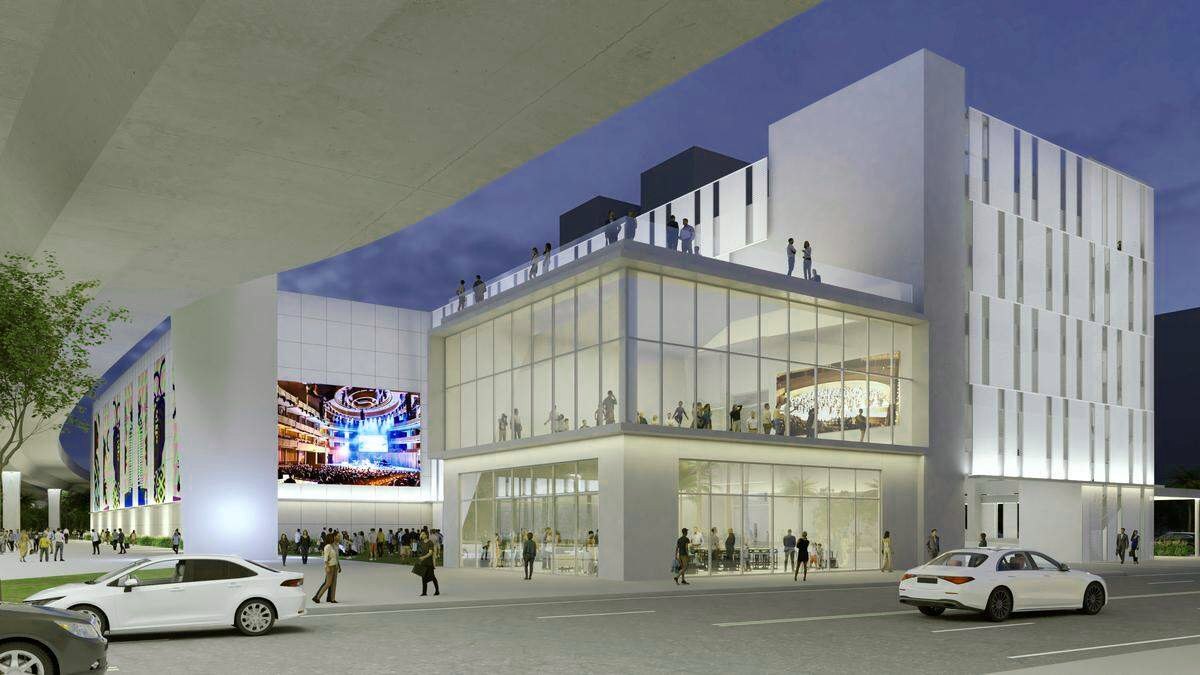
At the heart of the plan is a six-story precast parking structure designed to deliver roughly 750 parking spaces—capacity that the trust frames as essential to the center’s long-term accessibility as downtown development continues to reshape the neighborhood. The trust’s announcement positions the project as more than an infrastructure upgrade. It is presented as a practical response to a recurring barrier for audiences—getting in and out efficiently on performance nights—while also expanding the center’s ability to host educational and community activity.
If approved, the project would be led by Servitas construction management. The trust estimates the overall cost at about $61 million and says the center would continue operating as usual during construction—an important promise for a venue that produces more than 400 events annually and hosts year-round programming.
In public remarks included with the announcement, Arsht Center President and CEO Johann Zietsman described the plan as a guest-focused and community-focused solution—one that aims to expand access to arts and education while making it more attractive and convenient for patrons to attend performances.
Ownership, Operations, and Expansion Site
– Who owns vs. who runs it: Miami-Dade County owns the Arsht Center buildings and the adjacent parcel; the nonprofit Arsht Center Trust operates the venue and is the applicant for the expansion.
– Where the expansion goes: the garage/studio project is planned for adjacent county-owned land designated for Arsht Center parking.
– Why it’s urgent (in plain terms): as nearby surface lots and third-party options become less predictable with downtown development, the trust is positioning on-site parking as a reliability issue for show nights and school-day programming.
Details of the Proposed Parking Garage
The proposed garage is designed as a purpose-built facility for a major performing arts venue—where the challenge is not just storing cars, but moving large volumes of people in tight windows before curtain time and after final bows. The trust’s plan emphasizes capacity, flow, and flexibility, while also incorporating space meant for programming rather than treating the structure as a purely utilitarian add-on.
A key element is that the garage would be vertical—allowing the project to fit on the available county-owned parcel while still delivering a meaningful number of spaces. The trust has also said the vertical height is designed to accommodate potential future naming opportunities as a revenue source, signaling that the building’s profile and visibility are part of its financial strategy as well as its architecture.
Beyond standard patron parking, the plan explicitly accounts for the Arsht Center’s education footprint. The facility would include space for 30 school buses, a detail that reflects how frequently student groups and youth programs move through the campus. The trust also highlights “efficient ingress and egress,” language that points to the operational reality of performance nights: concentrated arrival and departure surges that can quickly turn parking into a deterrent.
The garage is also tied to a broader campus expansion concept that includes new studios/community spaces. In the trust’s framing, those spaces are not incidental—they are part of how the project “extends the Arsht’s mission” in the downtown neighborhood and strengthens the district’s cultural identity.
Optimized Event-Night Traffic Flow
Event-night flow (what the design is trying to optimize):
1) Pre-arrival: patrons choose a route and (if offered) reserve/pay for parking alongside ticket purchase.
2) Ingress: vehicles funnel into the garage during a short pre-show peak; “efficient ingress” typically means clear entry points, quick payment/validation, and minimal conflict with pedestrian crossings.
3) Park + walk: patrons park and take the shortest, safest path to the lobby doors (lighting, signage, and crosswalk placement matter here).
4) Bus staging (separate need): school buses require turning room and a predictable staging/loading zone so large student groups can unload safely without blocking car queues.
5) Post-show egress: the biggest stress test—hundreds of cars leaving at once—so exit lanes, signal timing, and wayfinding determine whether the experience feels smooth or gridlocked.
Structure and Capacity
The trust’s proposal calls for a six-story precast parking structure with about 750 spaces. Precast construction is commonly used for garages because it can speed assembly and standardize structural components, and the trust’s timeline expectations—completion anticipated within 14 months—align with a project that aims to minimize disruption while delivering a large, durable facility.
Capacity is central to the pitch. The Arsht Center produces more than 400 annual events, and the trust’s plan is built around the idea that a dedicated supply of on-site parking is not a luxury but a baseline requirement for a high-volume venue. In recent years, downtown Miami’s rapid development has reduced the availability of nearby surface lots and other third-party options, intensifying the pressure for a permanent solution.
That feature matters because the Arsht Center’s learning programs reach large numbers of children each year, and bus logistics are fundamentally different from standard vehicle parking: they require turning radii, staging space, and safe loading/unloading considerations. By including bus capacity in the garage plan, the trust is effectively treating student access as a core design requirement rather than an afterthought.
The expansion would be built on adjacent county-owned land designated for Arsht Center parking. While the county owns the land and the existing Arsht Center buildings, the trust is positioning itself as the project driver—submitting the application, assembling financing, and managing delivery.
Design Features
The trust’s announcement highlights “efficient ingress and egress” as a defining design feature—an acknowledgment that the user experience at a performing arts center is shaped as much by arrival and departure as by what happens inside the theater. Unlike office or residential garages with staggered traffic throughout the day, a performance venue must handle sharp peaks: hundreds of vehicles arriving within a narrow pre-show window and leaving almost simultaneously afterward.
Another notable design element is the building’s vertical height being planned to accommodate potential future naming opportunities as a revenue source. In practical terms, that suggests the structure is being conceived not only as infrastructure but also as an asset with branding potential—something visible enough, and designed intentionally enough, to attract a naming partner down the line.
The garage is also planned to include 5,000 square feet dedicated to cultural programming, split into two 2,500-square-foot spaces. The trust describes these as spaces that would extend the Arsht’s mission in the downtown Miami neighborhood and help cement the area’s identity as an arts and culture district. That programming footprint is significant because it signals a hybrid approach: the building is meant to serve audiences arriving by car, but also to create additional room for rehearsals, development, or community-facing cultural activity.
Finally, the plan’s inclusion of bus space—30 school buses—functions as a design feature as much as a capacity metric. It indicates the garage is being tailored to the Arsht Center’s educational operations, where large student groups need predictable, safe access. In a city where traffic, curb space, and event-night congestion can quickly become barriers, designing for buses is a concrete way to protect the reliability of school and youth programming.
This article reflects publicly available information at the time of writing, including figures and details shared by the Adrienne Arsht Center Trust and widely reported elsewhere. Timelines and operating specifics such as pricing, reservations, and traffic routing may change as approvals and permitting progress. For the latest event-night guidance, refer to the Arsht Center’s official updates.