

Table of Contents
- Kirk Munroe Park to receive $5 million upgrades
- Overview of the Kirk Munroe Park Transformation
- Funding Breakdown for the Project
- Planned Upgrades to Kirk Munroe Park
- Redesigning Fuller Street
- The Ziggurat Development Project
- Historical Significance of Kirk Munroe Park
- Construction Timeline for the Ziggurat
- Community Concerns Regarding the Project
- Potential Benefits of the Redevelopment
- Transforming Community Spaces: The Future of Kirk Munroe Park
- A New Era for Coconut Grove
- Balancing Development and Community Needs
Coverage note: This update is written from the perspective of HireDriverMiami.com’s local travel and neighborhood-news blog, focusing on how major public-space and streetscape changes in Coconut Grove may affect day-to-day visitor and resident experience.
Kirk Munroe Park to receive $5 million upgrades
$5M Park and Street Upgrades
– Total upgrade package: $5 million (Kirk Munroe Park + Fuller Street)
– Approved by: Miami City Commission (funding agreement approved Jan. 22)
– Who pays: City of Miami $3M + Allen Morris Company $2M
– What changes in the park: tennis court work, rebuilt hitting wall, children’s play area, landscaping, water features, decorative elements
– What changes on Fuller Street: decorative pavers, landscaping, specimen trees, signage
– Key checkpoint before work starts: final plans return to the city commission for approval
- Miami approved a $5 million public-space upgrade package for Kirk Munroe Park and Fuller Street in Coconut Grove.
- The City of Miami will contribute $3 million, with $2 million coming from Allen Morris Company, developer of the adjacent Ziggurat project.
- Planned park work includes tennis court renovations, a rebuilt hitting wall, a children’s play area, landscaping, water features, and new decorative elements.
- Fuller Street is slated for a redesign with decorative pavers, landscaping, specimen trees, and signage, with final plans returning to the city commission before construction.
Overview of the Kirk Munroe Park Transformation
Coordinated Park-Street Redevelopment Update
This project pairs a public park + a public street with an adjacent private development (Ziggurat) so the spaces function as one connected, walkable area. The city funds most of the work, while the developer helps pay and is expected to lead design/construction—then must bring final plans back to the commission.
Update context: the funding agreement was approved Jan. 22, and several timeline details are still being reported differently across sources and project materials.
A $5 million package of improvements is poised to reshape Kirk Munroe Park—one of Coconut Grove’s most-used neighborhood recreation spaces—along with nearby Fuller Street. The effort is a joint initiative between the City of Miami and Allen Morris Company, the developer behind the neighboring Ziggurat mixed-use project immediately south of the park.
The Miami City Commission approved the funding agreement on Jan. 22, setting the framework for how the upgrades will be designed, built, and paid for. Under that framework, Allen Morris Company is expected to lead design and construction, with final plans returning to the city commission for approval before work begins. The stated intent is twofold: modernize and beautify public amenities that residents already rely on, and create a more seamless physical connection between the park, Fuller Street, and the Ziggurat development’s pedestrian-oriented courtyard and paseos.
Kirk Munroe Park today functions as a compact but active community hub, with tennis courts, a playground, hitting walls, and open lawn space that draws families, children, and residents throughout the week. The planned work targets both the park’s core recreational infrastructure (notably tennis facilities) and its look-and-feel through landscaping, decorative perimeter fencing, and other aesthetic upgrades.
Fuller Street, meanwhile, is set to receive a redesign emphasizing streetscape improvements—decorative pavers, landscaping, specimen trees, and signage—intended to complement the adjacent development and enhance the public realm.
A key feature of the arrangement is that the developer will lead the design and construction process, with final plans to be submitted to the city commission for approval before work begins. Supporters describe the partnership as a way to deliver a higher-quality public-space upgrade that aligns with the neighborhood’s character. Critics, however, have raised questions about transparency, public input, and whether the improvements could blur the line between public park space and private development amenities.
Funding Breakdown for the Project
| Funding / cost rule | What the agreement says | Why it matters to residents |
|---|---|---|
| Total project budget | $5 million | Sets expectations for scope (park + Fuller Street) and what “fits” without cuts. |
| City of Miami contribution | $3 million | City is the larger funder, which shapes expectations about public control and accountability. |
| Allen Morris Company contribution | $2 million | Private dollars can expand scope/speed, but can also raise concerns about influence. |
| Cost overruns | Covered proportionally by city + developer | Reduces the chance one party absorbs all overruns, but still leaves open how overruns affect scope/timing. |
| Design-cost credits | Developer can credit prior design expenditures toward its contribution | Drives questions about how much of the $2M is new spending vs. earlier work already done. |
Under the agreement approved by the Miami City Commission on Jan. 22, the City of Miami is contributing $3 million, while Allen Morris Company is contributing $2 million.
That cost-sharing structure is central to both the project’s appeal and its controversy. On one hand, it represents a significant private contribution toward public infrastructure—money that, in theory, can accelerate improvements and expand the scope of what gets built. On the other, critics have argued that the city is putting in the larger share of capital while allowing the developer an outsized role in design and construction management.
The agreement also anticipates the possibility that the project could exceed its initial $5 million estimate. If costs run over, the city and the developer are expected to cover overruns proportionally, rather than shifting the entire burden to one party.
Another point raised by critics is that Allen Morris is allowed to credit prior design expenditures toward its financial contribution. That detail has fueled skepticism among some residents who want clearer accounting of what portion of the developer’s $2 million is new spending versus already-incurred costs.
Even with those concerns, the funding plan reflects a broader trend in fast-growing neighborhoods: public agencies partnering with adjacent private development to upgrade streetscapes and parks that will serve both existing residents and future users. In Coconut Grove, where the Ziggurat project is designed to bring office space, ultra-luxury residences, and retail into a highly walkable area, the condition and character of nearby public spaces becomes part of the neighborhood’s overall experience.
Planned Upgrades to Kirk Munroe Park
Park and Tennis Enhancements
– Tennis courts: resurfacing, striping, and fencing
– Tennis area: rebuild the hitting wall
– Tennis center: exterior improvements
– Families/kids: create a children’s play area
– Banyan tree area: add wood decking under the banyan tree
– Park feel: landscaping + water features
– Edges/grounds: decorative perimeter fencing + turf replacement
The planned improvements to Kirk Munroe Park focus on both recreation and atmosphere—upgrading the facilities people use daily while adding design elements intended to make the park more inviting and cohesive.
On the recreation side, tennis is a major emphasis. The plan calls for resurfacing, striping, and fencing the tennis courts, along with rebuilding the hitting wall. Exterior improvements to the tennis center are also included, signaling that the project is not limited to court surfaces alone but extends to the supporting structures that shape how the tennis area functions.
For families and younger visitors, the project includes creating a children’s play area. The park already serves as a gathering place for children and families, and the addition is framed as a way to preserve and enhance that role rather than replace it.
Beyond sports and play, the upgrades lean heavily into landscaping and placemaking. Plans include adding wood decking under the park’s banyan tree—an element that suggests a more intentional gathering or seating area beneath one of the park’s defining natural features. Landscaping and water features are also part of the package, along with decorative perimeter fencing and turf replacement.
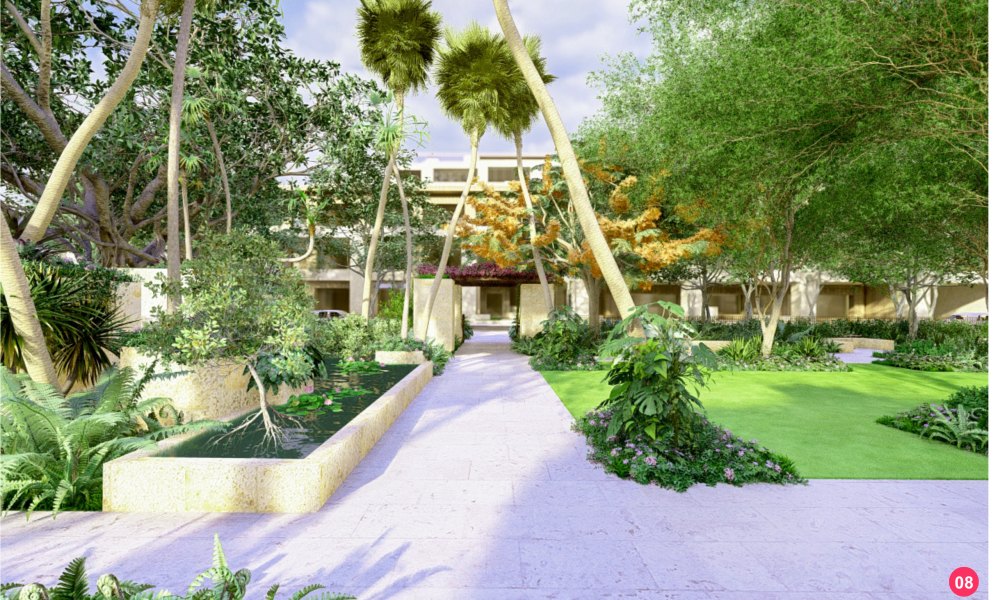
Early renderings prepared by Naturalficial, a landscape architecture firm involved in preliminary designs, have depicted an open lawn and a central water feature, alongside enhanced landscaping and decorative elements. While renderings are not final construction documents, they offer a window into the aesthetic direction: greener, more curated, and more aligned with the adjacent development’s design language.
One proposed element that drew strong reaction was a concession building. That concept was initially included but later removed after public backlash, including objections tied to the idea of selling alcohol across from a school. The removal illustrates how specific program choices—what gets built, not just how it looks—can quickly become flashpoints in a neighborhood where public space is intensely valued.
Taken together, the park upgrades aim to modernize worn infrastructure, improve usability, and refresh the park’s identity—while also setting the stage for a closer physical relationship between the park and the Ziggurat development next door.
Redesigning Fuller Street
Fuller Street Improvement Timeline
1. Developer-led design begins: Allen Morris Company leads design for Fuller Street improvements (pavers, landscaping, trees, signage).
2. Draft plans circulate: concepts and renderings may be shared publicly, but they are not the final construction set.
3. City checkpoint: final plans return to the city commission for approval before work begins.
4. Construction phase: streetscape work proceeds (expect temporary changes to walking routes, parking/loading, and access).
5. Closeout + handoff: completed public improvements become part of the day-to-day public realm alongside the Ziggurat site.
Fuller Street is slated for a redesign that emphasizes streetscape aesthetics and pedestrian experience, aligning it more closely with the public-facing character of the adjacent Ziggurat development. The plan includes decorative pavers, landscaping, specimen trees, signage, and other aesthetic improvements—an approach that suggests Fuller Street is being treated not just as a roadway, but as a public corridor meant to be walked, lingered in, and visually enjoyed.
The redesign is also described as part of a broader effort to create a pedestrian-friendly paseo integrated with the Ziggurat project. That matters in Coconut Grove, where walkability and the feel of streets and small public spaces are central to the neighborhood’s appeal. A street treatment that prioritizes paving materials, trees, and signage can change how people move through the area—slowing traffic psychologically, encouraging foot traffic, and making the transition between park space and development feel less abrupt.
Under the agreement, Allen Morris Company will lead the design and construction process for the Fuller Street work, with final plans submitted to the city commission for approval. That sequencing—developer-led design followed by commission review—has become one of the key points residents watch, because it shapes when and how the public can weigh in on details that affect daily life, from the placement of trees to the look of signage.
Public discussion around Fuller Street has also reflected a broader tension: whether the redesign is primarily a neighborhood improvement or an extension of the Ziggurat project’s “front door.” Supporters argue that upgraded paving, landscaping, and trees are unambiguously positive for the public realm. Skeptics worry that design choices could subtly prioritize the development’s aesthetics and circulation patterns over existing community use.
Timeline expectations have varied across reporting. One account described construction on Fuller Street beginning in summer 2026 with completion in early 2028, while other project materials have pointed to Ziggurat construction beginning in late 2025 and finishing by the end of 2027. Regardless of the precise sequencing, the Fuller Street redesign is positioned as a connective tissue—linking a long-standing public park to a major new mixed-use project through a more curated, pedestrian-oriented streetscape.
The Ziggurat Development Project
| Project detail | What’s been reported |
|---|---|
| Site | 3101 Grand Ave., Coconut Grove (1.7 acres) |
| Approval | Approved by the Miami City Commission in December 2025 |
| Main components | Five-story office building + condominium + ground-floor retail |
| Office size | 100,000 square feet |
| Residential | 19 ultra-luxury residences |
| Retail | Approximately 40,000 square feet |
| Design team | Oppenheim Architecture (architecture); Collarte Interiors (interiors) |
| Landscape direction | Naturalficial |
| Notable features | Rooftop restaurant with Biscayne Bay views; central landscaped courtyard; pedestrian-friendly paseos |
The park and streetscape upgrades are closely tied—geographically and conceptually—to the Ziggurat development, a 1.7-acre mixed-use project at 3101 Grand Ave. in Coconut Grove. Approved by the Miami City Commission in December 2025, Ziggurat is planned as a five-story office building with 100,000 square feet of space, paired with a condominium component featuring 19 ultra-luxury residences. The project also includes approximately 40,000 square feet of ground-floor retail.
Design details have been a prominent part of the project’s identity. Ziggurat is designed by Oppenheim Architecture, with interiors by Collarte Interiors. Landscape design is directed by Naturalficial—the same firm connected to early renderings for the park upgrades—creating a through-line between the development’s outdoor spaces and the adjacent public realm.
Among the project’s notable features is a rooftop restaurant with views of Biscayne Bay, positioning the development not only as a workplace and residential address but also as a destination. At ground level, the project is planned around a central landscaped courtyard, with pedestrian-friendly paseos intended to connect the development to adjacent public spaces and the surrounding neighborhood.
That connective ambition is where Ziggurat intersects most directly with Kirk Munroe Park and Fuller Street. The public upgrades are framed as a way to “complete” the experience of moving through the area—park to street to courtyard—rather than treating the development as a self-contained enclave. In practice, whether that integration feels welcoming or exclusionary will depend on design execution: sightlines, entrances, fencing, signage, and the subtle cues that tell people where they belong.
The partnership structure—where the developer contributes funding and leads design/construction for public improvements—also reflects the reality that Ziggurat will benefit from adjacency to an upgraded park and a more attractive streetscape. For future office tenants, retail customers, and condominium residents, the quality of nearby public space can be a selling point. For existing residents, the question is whether those improvements preserve the park as a neighborhood asset first, rather than turning it into an amenity that primarily serves a luxury development.
Historical Significance of Kirk Munroe Park
Balancing Upgrades and Legacy
Kirk Munroe Park’s name ties it to Coconut Grove’s early civic story. Because it’s both a daily-use recreation spot and a neighborhood landmark, even “simple” upgrades (fencing, decking, water features) can feel high-stakes—people aren’t just reacting to design, but to what the place represents.
Kirk Munroe Park is more than a patch of green in Coconut Grove; it is a named place that reflects the neighborhood’s layered history and identity. The park is named after Kirk Munroe, described as a pioneering author, explorer, and early Coconut Grove settler. His legacy is tied to the community’s civic and cultural development, including founding the Biscayne Bay Yacht Club and helping establish the Coconut Grove Library.
That historical association matters because it frames the park as a community landmark rather than simply a recreational facility. In neighborhoods like Coconut Grove—where growth and redevelopment are constant pressures—named public spaces often become anchors of continuity. They hold memories: childhood tennis lessons, afternoons at the playground, informal gatherings on open lawns. Even when the physical infrastructure changes, the name and the shared understanding of what the place represents can shape how residents respond to redesign.
The planned improvements are presented as an effort to preserve and enhance the park’s usability for children, families, and residents. That language signals an awareness that the park’s value is rooted in everyday use, not just aesthetics. Upgrading tennis courts, rebuilding the hitting wall, and creating a children’s play area are all consistent with maintaining the park’s long-standing role as a recreational hub.
At the same time, the park’s historical significance can heighten sensitivity to change—especially when the changes are linked to a major private development next door. When a public space with a strong neighborhood identity is redesigned to “complement” a new luxury project, residents may worry that the park’s character could shift, even if it remains legally public.
The debate, then, is not only about benches, pavers, or landscaping. It is also about stewardship: who gets to shape the next chapter of a place that carries the name of an early settler and civic builder, and how that chapter reflects Coconut Grove’s broader story.
Construction Timeline for the Ziggurat
| Timeline item | What’s been stated | Where it’s attributed in the reporting |
|---|---|---|
| Ziggurat construction start | Late 2025 (expected) | Developer’s website (as described in reporting) |
| Ziggurat completion | End of 2027 (projected) | Developer’s website (as described in reporting) |
| Groundbreaking (alternate account) | December 2025 | Other reporting referenced in the article’s discussion |
| Fuller Street construction start (alternate account) | Summer 2026 | Other reporting referenced in the article’s discussion |
| Fuller Street completion (alternate account) | Early 2028 | Other reporting referenced in the article’s discussion |
The Ziggurat project’s timeline has been described in slightly different ways across sources, but the broad arc points to a multi-year buildout that overlaps with planning and execution for the adjacent public-space upgrades.
According to the developer’s website, construction on Ziggurat was expected to begin in late 2025, with completion projected by the end of 2027. Other reporting has described a different sequence for related work in the area, including Fuller Street construction beginning in summer 2026 with completion in early 2028. That schedule places the project’s most disruptive phases—site work, vertical construction, and finishing—squarely within a two-year window, a period during which nearby streets and public spaces can feel the effects of increased activity.
Other reporting has described a timeline in which groundbreaking occurred in December 2025, with Fuller Street construction beginning in summer 2026 and completion in early 2028. While those dates are not identical to the developer’s projection, they reinforce the same core point: the redevelopment of the area is not a quick refresh but a sustained transformation that will unfold over multiple years.
For residents and visitors, the sequencing matters. If Ziggurat construction begins first, the neighborhood may experience construction impacts before seeing the benefits of upgraded park and streetscape amenities. If park and street improvements proceed in parallel, the area could face overlapping disruptions—construction staging, temporary closures, and changes to pedestrian routes—followed by a more dramatic “after” moment when multiple pieces come online around the same time.
That step creates a formal checkpoint, though it does not by itself resolve questions about how much public input will shape the final design.
In practical terms, the timeline underscores that Coconut Grove is entering a transition period. The park upgrades and Fuller Street redesign are not isolated beautification projects; they are interwoven with the construction and eventual opening of a major mixed-use development that includes office space, ultra-luxury residences, retail, and a rooftop restaurant.
Community Concerns Regarding the Project
Balancing Speed, Design, and Accountability
– Speed vs. control: Developer-led delivery may move faster, but can feel like less public control over public assets.
– Beautification vs. “amenity” feel: Upgrades can improve comfort and usability, yet design cues (fencing, signage, circulation) can change who feels welcome.
– Private money vs. public accountability: A $2M private contribution helps fund the work, but the city is still the larger funder—raising expectations for transparency.
– Early concepts vs. final plans: Renderings can set expectations (or alarm), while the commission-approval checkpoint comes later.
– Construction benefits vs. construction disruption: Better courts/streetscape later may come with temporary access changes and neighborhood impacts during the build.
Even as the project promises visible improvements, it has sparked debate among residents and stakeholders—less about whether Kirk Munroe Park should be maintained, and more about who controls the process and what the redesign ultimately prioritizes.
A recurring concern has been transparency and public involvement. Some residents have criticized what they see as a process that advanced design concepts before fully gathering community input, creating distrust. Joseph Vergara, a local resident, argued that presenting designs before collecting public feedback can breed antagonism and skepticism. City officials and the developer have said public meetings will be held to gather feedback, though questions have lingered about timing and how much influence that feedback will have.
Another major worry is privatization—or, more precisely, the blurring of boundaries between public and private space. Because the upgrades are explicitly meant to complement the adjacent Ziggurat development, critics fear the park could begin to function like an amenity for a luxury project rather than a neighborhood-first public space. The concern is not necessarily that the park will become legally private, but that design cues, circulation patterns, and programming could subtly shift who feels welcome and who the space is “for.”
Specific design elements have also triggered pushback. A proposed concession building became a flashpoint and was later removed after public backlash, including objections to selling alcohol across from a school. That episode illustrates how quickly a single feature can reshape perceptions of the entire project—turning a discussion about landscaping and tennis courts into a broader argument about commercialization and neighborhood character.
There have also been disagreements about aesthetics. Some critics have described aspects of the redesign as overly commercialized, while others have argued that the emphasis on greenery and beautification has been misunderstood.
From the developer’s side, Allen Morris Company has emphasized that it sought input from local stakeholders early in the process, facilitated by the city’s District 2 community liaison. The company’s attorney has characterized the agreement as a way to streamline logistics rather than to dictate outcomes. Still, the fact remains: the developer is leading design and construction for public assets, and that structure—common in some redevelopment contexts—can feel uncomfortable in a neighborhood protective of its public realm.
Potential Benefits of the Redevelopment
Park Improvements and Connectivity
– Recreation & daily use: Better tennis courts, a rebuilt hitting wall, and a children’s play area improve the park’s core “everyday” functions.
– Comfort & place quality: Landscaping, turf replacement, decking under the banyan tree, and water features can make the park more pleasant to spend time in.
– Walkability & connections: Fuller Street’s pavers/trees/signage can strengthen the pedestrian link between park, street, and nearby destinations.
– Local activity & street life: Retail, office, and restaurant uses at Ziggurat may increase foot traffic—helpful if the public realm stays genuinely welcoming.
– Delivery speed (with oversight): A developer-led build can move faster than a fully city-run project, while still requiring commission approval of final plans.
For all the controversy, the planned upgrades to Kirk Munroe Park and Fuller Street also carry clear potential upsides—especially for residents, families, and visitors who use Coconut Grove’s public spaces as part of daily life.
First, the most direct benefit is improved public amenities. Resurfaced and re-striped tennis courts, new fencing, a rebuilt hitting wall, and exterior improvements to the tennis center could make the park’s sports facilities more functional and enjoyable. A dedicated children’s play area supports the park’s role as a family destination. Turf replacement, landscaping, and water features could improve comfort and visual appeal, particularly in a neighborhood where outdoor life is a major part of the lifestyle.
Second, the Fuller Street redesign could enhance walkability and the overall streetscape experience. Decorative pavers, specimen trees, landscaping, and signage can make a corridor feel safer and more pleasant for pedestrians, while also reinforcing Coconut Grove’s identity as a place where people move on foot between parks, shops, and gathering spots.
Third, integration with the Ziggurat development could bring more foot traffic and economic activity to the area. With approximately 40,000 square feet of ground-floor retail planned, plus office space and a rooftop restaurant, the project is designed to attract people throughout the day and evening. If the public realm is designed well, that activity can spill into nearby streets and public spaces in ways that support local businesses and enliven the neighborhood.
Fourth, supporters argue that partnering with a private developer can speed implementation compared with traditional public-sector delivery. When a developer leads design and construction—while still requiring city commission approval of final plans—the process may move faster than a fully city-managed capital project, though that speed can come with tradeoffs in perceived control and transparency.
Finally, there is a broader, place-based benefit: the chance to create a more cohesive connection between a long-standing public park and new development through pedestrian-friendly paseos and a landscaped courtyard. If executed with care, the result could be a more continuous network of public-facing spaces—park to street to courtyard—that feels greener, more inviting, and more usable for the wider community.
Transforming Community Spaces: The Future of Kirk Munroe Park
Coconut Grove is watching a familiar South Florida story unfold in real time: a historic neighborhood landmark is being upgraded alongside a major new development, with public and private money intertwined. The outcome will be judged not only by how new the tennis courts look or how lush the landscaping becomes, but by whether the park still feels like it belongs—unambiguously—to the community.
A New Era for Coconut Grove
The scale of change is significant. Ziggurat brings a five-story office building, ultra-luxury residences, ground-floor retail, and a rooftop restaurant into the immediate orbit of Kirk Munroe Park. At the same time, the park and Fuller Street are set for a redesign meant to complement that development and enhance the public realm.
If the upgrades deliver what’s promised—better recreation facilities, improved play space for children, refreshed turf, and a more walkable, tree-lined Fuller Street—Coconut Grove could gain a more polished, connected set of public spaces. For visitors considering the neighborhood, that can translate into a clearer sense of place: a park that’s active, a street that’s pleasant to stroll, and a cluster of destinations within easy walking distance.
Balancing Development and Community Needs
The central challenge is balance. The city and developer have structured the project so that Allen Morris leads design and construction, with final plans returning to the city commission for approval. That arrangement can deliver efficiency, but it also raises the stakes for transparency and meaningful public input.
For the redevelopment to succeed as a community project—not just a development-adjacent upgrade—the final designs will need to reinforce what Kirk Munroe Park already is: a recreational hub for residents, children, and families. The debate around the now-removed concession concept shows how sensitive the neighborhood is to signals of commercialization and exclusion.
In the end, the most important measure may be simple: when the construction fences come down, will longtime residents recognize their park—and feel just as welcome using it as they always have?